|
Report from
Europe
European plywood imports stabilise as anti-dumping
measures reshape supply
EU+UK plywood imports from outside the region totalled
1.96 million cu.m in the first half of 2026, 9% less than in
the same period last year. Import value fell 8% to US$909
million. As Chart 1a shows, the latest decline follows a
much larger adjustment from the peak of just over 5
million cu.m in the rolling 12 months to June 2022.
Imports on the same basis stood at 3.68 million cu.m in
June 2026. The decline this year was concentrated in the
first quarter, when volume was 14% below a year earlier.
Second-quarter volume was down only 4%, and June
imports were marginally higher than in June 2025.
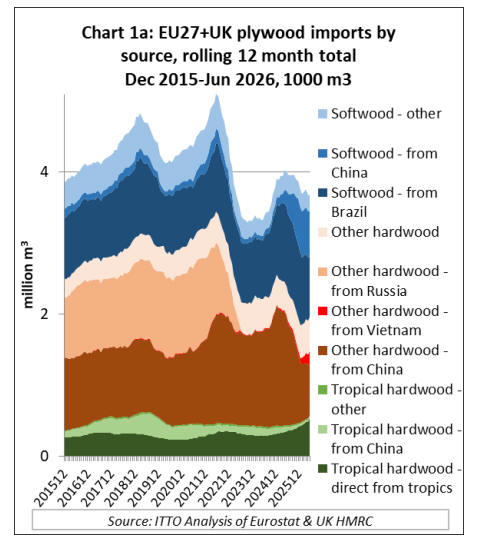
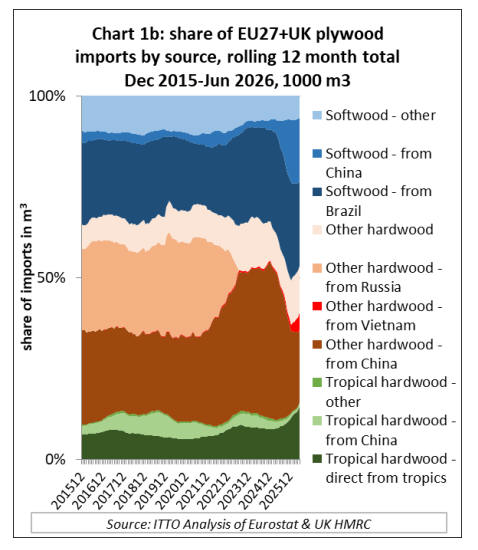
The longer term change is also one of supply sources.
Chart 1b shows the disappearance of Russian plywood
from EU+UK imports after 2022, followed more recently
by a sharp fall in China’s share of hardwood plywood
supplies and gains for other sources.
EU anti-dumping duties on Chinese hardwood plywood
have encouraged buyers to seek alternative hardwood
suppliers, most notably in Viet Nam. Duties on Brazilian
softwood plywood have added pressure on that source of
supply. The UK has not applied the same anti-dumping
measures, so the forces reshaping EU and UK imports
differ to some extent.
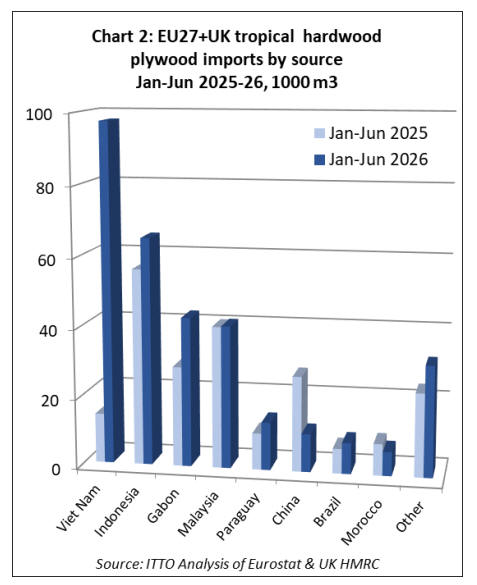
Tropical hardwood plywood imports rose sharply
EU+UK imports of plywood faced with tropical hardwood
reached 318,600 cu.m in the first half of 2026, up 46%
from a year earlier. Direct imports from tropical countries
rose 66% to 298,700 cu.m. Shipments from Viet Nam
classified as tropical hardwood plywood increased from
14,200 cu.m to 97,500 cu.m.
Imports from Indonesia rose 16% to 65,200 cu.m, while
those from Gabon increased 49% to 42,900 cu.m.
Malaysian shipments were little changed at 40,800 cu.m.
By contrast, imports of tropical hardwood plywood from
China fell 60% to 10,900 cu.m (Chart 2).
These figures are consistent with buyers replacing some
Chinese hardwood panels with direct imports from other
suppliers. The extent to which particular products are
interchangeable depends on their construction,
performance and price. Indonesian suppliers have reported
increased European orders for film-faced and combi
plywood, but their ability to expand production has been
constrained by log availability and rising costs.
Viet Nam’s growth also requires careful interpretation.
The classification used here distinguishes Viet Namese
plywood with a reported tropical hardwood face veneer
from other Viet Namese hardwood plywood. Viet Nam
processes imported timber, including temperate species,
and the exact proportion of plywood manufactured using
tropical and non-tropical hardwoods cannot be reliably
determined from available trade data.
Viet Nam takes a larger share of temperate hardwood
supply
Total EU+UK imports of temperate hardwood plywood
from outside the region fell 11% to 763,000 cu.m in the
first half of 2026. Imports from China were down 36% to
405,400 cu.m. The reduction was steepest in the first
quarter, at 44%; in the second quarter Chinese shipments
were 24% below a year earlier. China nevertheless
remained by far the largest individual supplier in this
product category (Chart 3).
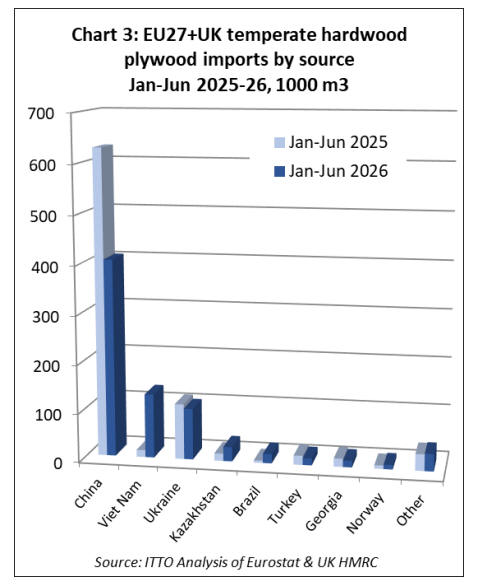
Viet Nam recorded the largest offsetting gain. EU+UK
imports of temperate hardwood plywood from the country
increased from 14,500 cu.m to 131,400 cu.m in the second
month period.
Combined with panels classified as tropical hardwood
plywood, imports from Viet Nam approached 229,000
cu.m in the first half, compared with fewer than 29,000
cu.m a year earlier.
US trade measures affecting Viet Namese hardwood and
decorative plywood have given exporters a reason to
develop other destinations, including Europe. The EU’s
duties on Chinese hardwood plywood provide a more
immediate reason for European buyers to consider Viet
Namese supply.
EU+UK imports of non-tropical hardwood plywood from
Brazil rose to 18,900 cu.m in the first half of 2026, almost
four times the volume in the same period last year. Imports
from Kazakhstan nearly doubled to 29,500 cu.m, whereas
those from Ukraine fell 8% to 105,000 cu.m.
Brazilian softwood plywood imports decline
EU+UK imports of softwood plywood from outside the
region fell 19% to 881,100 cu.m in the first half of this
year. Shipments from Brazil, still the largest supplier,
declined 25% to 583,900 cu.m (Chart 4). The fall from
Brazil deepened from 21% in the first quarter to 29% in
the second. The EU’s definitive anti-dumping duty of
5.4% on most Brazilian softwood plywood imports took
effect in April, following provisional measures imposed in
November 2025.
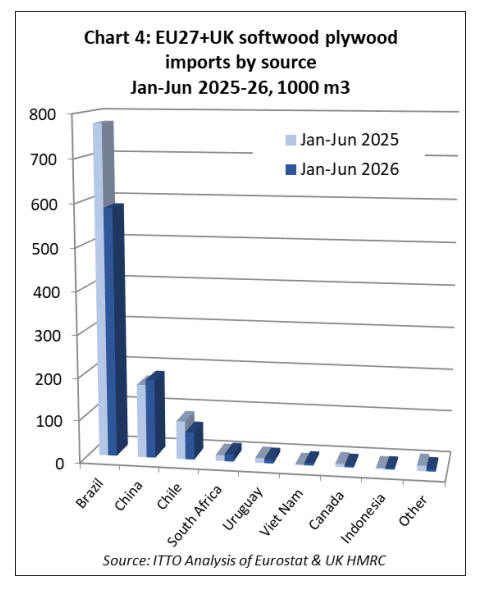
EU+UK imports of Chinese softwood plywood rose 7% to
185,400 cu.m in the first half of 2026, following
exceptionally rapid growth during 2025. Some substitution
towards this product remains evident, but its earlier growth
rate has slowed: second-quarter imports were 2% below
the corresponding period last year.
Classification of Chinese plywood is also becoming a
trade-enforcement issue. In July, the European
Commission opened an investigation into whether certain
panels with thin coniferous or bamboo outer plies and
hardwood cores circumvent the duties on Chinese
hardwood plywood.
Is EU production being boosted by anti-dumping
measures?
There is some evidence that European hardwood plywood
production is benefiting from the anti-dumping duties.
Finnish industry figures show that Finland produced
approximately 0.4 million cu.m of plywood in the first half
of 2026, 5.2% more than a year earlier.
Plywood machinery supplier Raute reports that European
hardwood plywood demand has picked up and that exports
from Nordic and Baltic producers approached some of
their highest levels in recent years. Finnish producer
Koskisen describes demand for its birch plywood as good,
with slightly higher selling prices in the second quarter.
In contrast to hardwood, the EU softwood plywood sector
seems to be struggling. Raute describes European
softwood plywood demand as notably weaker, and Finnish
producer Metsä Group ceased production at its Suolahti
softwood plywood mill at the end of May. Koskisen
reports continuing pressure on European plywood
producers from rising raw material, freight and production
costs.
See: https://news.cision.com/raute-oyj/r/raute-s-half-year-
financial-report-january-june-2026--strong-operational-
performance-supported-
profi%2Cc4382269?utm_source=chatgpt.com
and
https://koskisen.fi/en/releases/koskisens-revenue-increased-high-
raw-material-costs-and-lower-by-product-prices-weighed-on-
profitability/?utm_source=chatgpt.com
Weak construction limits the outlook
The modest improvement in second-quarter imports
should be considered alongside mixed demand indicators.
EU GDP grew 0.7% between the first and second quarters
of 2026, with household consumption making a positive
contribution. Construction was less encouraging. Revised
Eurostat figures show EU construction output falling 1.3%
in June compared with May; by July it was 1.8% below a
year earlier, with construction of buildings down 5.6%.
In the UK, GDP and household consumption rose 0.4%
and 0.3% respectively in the second quarter. Construction
output increased slightly from the first quarter but
remained 2.0% below its level a year earlier, while new
construction orders fell 11.8% quarter on quarter.
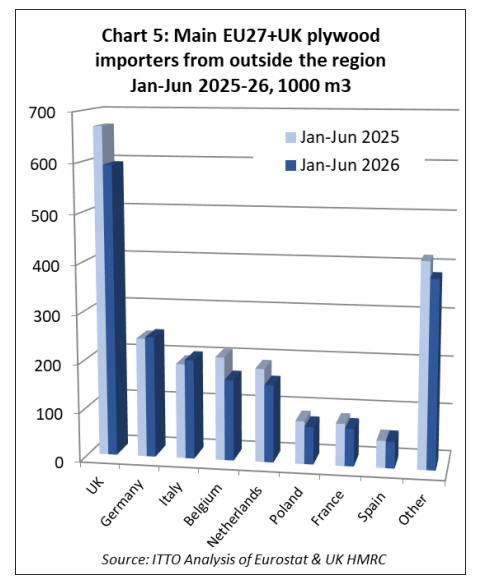
UK imports of plywood from outside the EU and UK
region totalled 593,600 cu.m in the first half, down 11%.
The UK continued to account for around 30% of all EU
and UK plywood imports from outside the region. Imports
into Germany and Italy rose slightly, while those into
Belgium and the Netherlands declined.
Differences between destinations may also reflect
stockholding and distribution, as well as final consumption
(Chart 5).
Policy measures set to further impact on supply
Overall, the first-half data suggest that the sharp
contraction in EU+UK plywood imports was easing by
mid-year. There is clearer evidence of significant shifts in
sourcing than of any change in underlying demand. EU
anti-dumping duties have substantially altered the
commercial position of Chinese hardwood and Brazilian
softwood plywood in this market. Viet Nam and direct
tropical suppliers have gained share, and there are early
indications of improved conditions for some European
hardwood plywood mills.
Construction weakness, production costs, the availability
of suitable alternative panels and other emerging policy
issues will determine whether those gains develop into a
broader sustained recovery for European and tropical
plywood manufacturers in the market.
Of other policy issues, the potential impact of the EU
Deforestation Regulation once enforcement begins on 30
December 2026 is uncertain and may be far reaching.
Some key exporters to the EU see it offering potential
advantages for their well-established timber-tracking
systems; others report that compliance costs, together with
weak European demand, are encouraging producers to
develop alternative destinations.
There is also a new EU restriction on formaldehyde
emissions from wood-based articles which took effect on 6
August 2026. The limit of 0.062 mg/cu.m under specified
test conditions applies to plywood placed on the EU
market, subject to exemptions including certain
construction products used exclusively outside the
building shell and vapour barrier. The requirement may
favour suppliers able to document low-emission panels.
Looking further ahead, wood-based panels are included in
the EU’s 2026–29 programme to update harmonised
construction-product standards.
Although existing CE-marking arrangements under EN
13986 continue during the transition, the review is
expected to bring further changes to performance and
environmental declarations for plywood used in buildings,
including structural applications in the next few years.
|


