US Dollar Exchange Rates of
25th
September
2026
China Yuan 6.71
Report from China
Circumvention investigation into Chinese hardwood
plywood
In July, the European Commission officially released the
implementing regulations initiating the launch of a
possible circumvention investigation into the hardwood
plywood that originated from China and underwent
surface simple modification treatment.
At the same time, import registration supervision measures
were implemented for the involved products. This
investigation was initiated in response to the application
submitted by the European Wood Industry Alliance in
June 2026 and reportedly involves over 300 plywood
export enterprises in China.
The Applicant believes that since November 2025 when
the EU imposed a maximum 86.8% anti-dumping duty on
Chinese hardwood plywood, some enterprises have
adopted a minor physical modification method by adding
thin (less than 2.5 millimetres) coniferous veneers,
bamboo bark finishes or artificial thin wood containing
coniferous and bamboo materials to the surface of the
hardwood plywood, to classify their products under other
tariff codes for export and thereby avoid the anti-dumping
duty.
The investigation target includes plywood with all outer
layers being coniferous or bamboo materials and each
outer layer having a thickness less than 2.5 millimetres, as
well as plywood with tropical wood or non-coniferous tree
species veneers as the core material and artificial thin
wood as the outer layer.
The European Commission believes that the Applicant has
provided sufficient evidence to show that after the
implementation of anti-dumping measures against China,
the trade flow of Chinese exports to the EU has changed.
The original restricted products have been largely replaced
by slightly modified products, which has weakened the
effectiveness of the current anti-dumping measures and
there is evidence of exporting to the EU market at
dumping prices.
See:
http://www.cnfpia.org/sf_C9E4DEB433D64DE78475B24D07A
3720F_297_9E5BA0FB363.html
and
file:///C:/Users/hp/AppData/Local/Temp/OJ_L_202601840_EN_
TXT.pdf
Rise in bamboo furniture exports
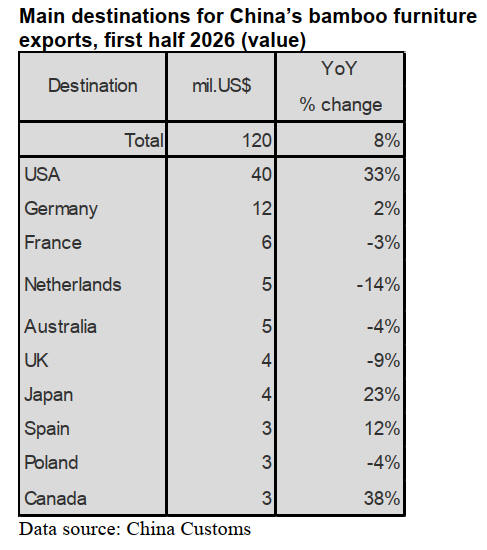
According to China Customs, the total value of China’s
bamboo furniture exports rose 8% to US$120 million in
the first half of 2026. The value of China’s bamboo
furniture exports to the US, the largest destination country,
grew 33% to US$40 million over the same period of 2025.
34% of China’s bamboo furniture is exported to the US.
This increase directly resulted in the rise in the total value
of China’s bamboo furniture exports in the first half of
2026.
The destinations for China’s bamboo furniture exports are
numerous and China’s bamboo furniture is exported to
over 140 destination countries. The proportion of China’s
bamboo furniture exports to the top 10 destination
countries was 73% in the first half of 2026.
Germany was the second largest destination for China’s
bamboo furniture exports. 10% of China’s bamboo
furniture was exported to Germany. In the first half of
2026, the value of China’s bamboo furniture exports to
Germany rose 2% to US$12 million over the same period
of 2025.
In addition, China’s bamboo furniture exports to Japan,
Spain and Canada increased by 23%, 12% and 38%
respectively in the first half of 2026. In contrast, the value
of China’s bamboo furniture exports to France,
Netherlands, Australia, UK and Poland fell 3%, 14%, 4%,
9% and 4% in the first half of 2026.
In the first half of 2026, the export of Chinese bamboo
furniture saw an increase. The main factors were the
following:
Exemption from the EU EUDR regulations.
Bamboo furniture does not have to bear the
complex zero-deforestation traceability costs
associated with solid wood furniture, making it
the preferred choice for overseas buyers as an
alternative to wooden furniture.
Coupled with the global trend of green and low-
carbon consumption, the fast growth rate, low-
carbon and environmentally friendly
characteristics of bamboo have gained favor in
the European and American markets.
The domestic industry has a complete bamboo
processing chain with stable raw materials and
mature techniques and high product cost-
effectiveness.
Additionally, the expansion of channels such as
cross-border e-commerce and Canton Fair has led
to an increase in overseas demand for outdoor
furniture, with concentrated orders being
released, jointly boosting the export of bamboo
furniture.
Rise in bamboo furniture imports
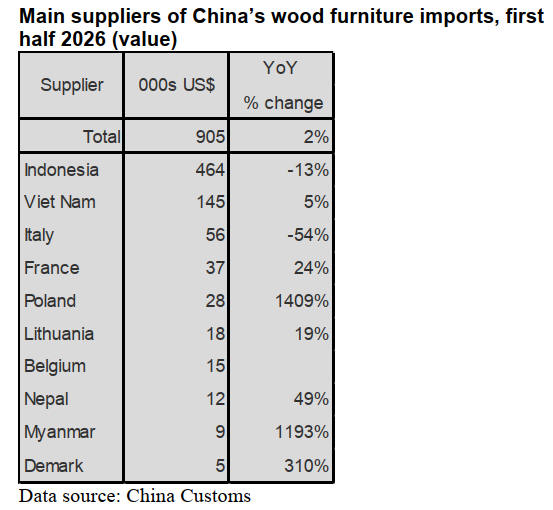
According to China Customs, in the first half of 2026 the
total value of China’s bamboo furniture imports rose 2%
to US$905,000 over the same period of 2025.
Indonesia and Viet Nam are the top two suppliers for
China’s bamboo furniture imports and 67% of China’s
bamboo furniture are imported from the above-mentioned
two countries in the first half of 2026.
In the first half of 2026 China’s bamboo furniture imports
from Indonesia fell 13%, but from Viet Nam rose 5% over
the same period of 2025. It is worth noting that China’s
bamboo furniture imports from Poland and Myanmar
surged over 1000% in the first half of 2026.
The main reasons for the increase in the value of China’s
bamboo furniture imports were:
The demand for differentiated and original
bamboo furniture in commercial spaces such as
high-end homes and guesthouse hotels in China
had risen.
The domestic bamboo industry mainly focuses on
standardised mass-produced products, while
imported bamboo furniture mostly comes from
Southeast Asia, Italy, and Japan. It mainly
consists of handcrafted products made of rattan
and bamboo, as well as overseas original design
products. These are in contrast and complement
each other with domestic products.
Coupled with the tariff benefits of ASEAN and
the expansion of processing capacity for bamboo
and rattan in Southeast Asia import procurement
costs has decreased.
At the same time, the green home consumption in
China has risen and designers tend to choose low-
carbon bamboo products to replace some solid
wood furniture. The expansion of cross-border
home channels has further driven orders, pushing
up the scale of bamboo furniture imports.
Production capacity of wood-based panel remained
relatively stable
The industrial monitoring data from the Industry
Development Planning Institute of the National Forestry
and Grassland Administration shows that in the first half
of 2026 the plywood and fibreboard industries in China
witnessed a slight decrease in the number of enterprises
and a basically stable production capacity. The
particleboard industry showed a slight decrease in the
number of enterprises and a slowdown in the growth of
production capacity.
Plywood
As of the end of June 2026 there were over 4,980 plywood
manufacturing enterprises across 26 provinces
(municipalities and autonomous regions), approximately
30 fewer than at the end of 2025. The total production
capacity was about 247 million cubic metres per year, an
increase of 0.4% compared to the end of 2025. The
plywood industry presented a situation of a slight decrease
in the number of enterprises and a basically stable total
production capacity.
Fibreboard
In the first half of 2026, 2 fibreboard production lines were
completed and put into operation in China, adding a
production capacity of 430,000 cubic metre per year.
As of the end of June there were 216 fibreboard
manufacturing enterprises in China, with 239 fibreboard
production lines, distributed in 21 provinces
(municipalities and autonomous regions), with a total
production capacity of 40.54 million cubic metres per year
and a net increase in production capacity of 1.7 million
cubic metres per year.
Of the total, there were 118 continuous flat-press lines
with a combined production capacity reaching 26.39
million cubic metres per year, accounting for 65% of the
total production capacity.
Overall, the fibreboard industry showed a trend of further
decline in the number of enterprises and production lines,
while the total production capacity remained basically
stable. Currently, there is one fiberboard production line
under construction nationwide, with a production capacity
of 300,000 cubic metres per year.
Particleboard
In the first half of 2026 3 particleboard production lines
(including 3 continuous flat-press lines) were completed
and put into operation, adding a production capacity of
900,000 cubic metres per year.
As of the end of June 2026 there were 286 particleboard
manufacturing enterprises in China, with 308 particleboard
production lines, distributed in 21 provinces
(municipalities and autonomous regions). The total
production capacity reached 66.19 million cubic metres
per year, with an additional production capacity of
660,000 cubic metres per year, increasing by 1.0%
compared to the end of 2025.
Of the total, there were 152 continuous flat-press lines
with a total production capacity of 50.59 million cubic
metres per year, accounting for a further increase in the
proportion of 76% of the total production capacity.
The particleboard industry showed a trend of stable
enterprise numbers and production line quantities with the
total production capacity growth slowing down. Currently,
there are 15 ongoing particleboard production lines in
China, with a combined production capacity of 3.85
million cubic metres per year and the phased investment
risks in the particleboard industry still exist.
See: https://www.greentimes.com/greentimepaper/html/2026-
08/26/content_3399316.htm
Steady growth in forestry machinery trade
According to China Customs and statistics from the China
Forestry Machinery Association, in the first half of 2026
the total value of major forestry machinery products trade
in China reached US$10.655 billion, with a year-on-year
growth of 4.6%. Of the total, the import value was
US$309 million, a year-on-year decrease of 13%, the
export value was US$10.346 billion, a year-on-year
increase of 5%.
Overall, in the first half of 2026, the trade of major forest
machinery products in China maintained a upward trend
and exports remained the main driving force for the
industry's foreign trade growth.
GTI report - August
From January to July this year China’s log imports
registered a year-on-year decline yet the total import value
remained largely flat compared with the same period last
year suggesting an overall uptick in average import prices.
During the same period, China’s exports of furniture and
parts reached approximately US$39.19 billion, up 8.5%
year on year, signaling a shift from the downward trend
seen last year to a growth territory.
Analysts point out that Chinese furniture exports are
gradually moving away from their previously concentrated
market structure toward a more diversified geographical
footprint, with a number of manufacturers accelerating
their push into markets such as the Middle East, Southeast
Asia and Latin America to reduce reliance on any single
market.
Entering August, extreme weather conditions across the
country begun to subside and with the traditional "Golden
September and Silver October" peak-season stocking
window drawing closer industry insiders maintained a
cautiously optimistic outlook on the near-term
performance of the domestic building materials and home
furnishing market.
In August 2026 the GTI-China index registered 41.7%, a
decrease of 1.3 percentage points from the previous month
and below the critical value (50%) for four consecutive
months indicating that the business prosperity of the
timber enterprises represented by the GTI-China index
shrank from the previous month.
Regarding the twelve sub-indexes, three indices (inventory
of finished products, import, and market expectation) were
above the 50% critical value, one index (export orders)
was at the value, while the remaining eight indices
(production, new orders, existing orders, purchase
quantity, purchase price, inventory of main raw materials,
employees and delivery time) were below the critical
value.
Compared to the previous month, the indices for export
orders, inventory of finished products, purchase quantity,
purchase price, import, inventory of main raw materials
and delivery time increased by 2.1 to 13.9 percentage
points, whereas the indexes for production, new orders,
existing orders, employees and market expectation
declined.
The main challenges reported by GTI-China enterprises
for August were: insufficient orders, rising costs of raw
materials, weak demand and intense competition in
international and domestic markets.
Overall demand for wood in China has declined due to
slowing economic growth. In particular, the slowdown in
the real estate market has both directly reduced new
construction and led to a negative wealth effect, where
Chinese consumers (whose savings are heavily
concentrated in real estate) are spending less on consumer
goods. This trend has affected both softwoods and
hardwoods.
Changing trade patterns have also had an effect. Exports
of finished wood products from China have decreased due
to weaker global economic conditions in key export
markets, global trade disputes and changes in buyer
preferences. In addition, some countries have introduced
stricter import and environmental rules, making it harder
for China to export certain wood products. For hardwoods,
this has impacted both furniture and flooring exports from
China.
In the furniture industry, hardwood used in solid wood
furniture is facing increasing competition from composite
wood products. The use of solid wood has declined not
only because it is more expensive, but also because
younger people are more likely to rent homes and prefer
furniture that is less costly and easier to move when they
relocate.
However, families with children often prefer solid wood
furniture as it is widely believed to be more
environmentally friendly and healthier for children. Solid
wood furniture is marketed as containing fewer chemical
substances compared to composite or engineered wood
products making it a popular choice among parents
concerned about indoor air quality and the well-being of
their families.
See: https://www.fas.usda.gov/data/gain-
report/2026/04/Hardwood%20Market%20Update%202026_Shan
ghai%20ATO_China%20-
%20People%27s%20Republic%20of_CH2026-0055.pdf
|


