Japan
Wood Products Prices
Dollar Exchange Rates of 25th
September
2026
Japan Yen 157.28
Reports From Japan
Interest rate up again - shortest interval since 2024
In response to rising costs due to crude oil prices and the
weakening yen, the Bank of Japan raised its policy rate to
1.25%, just three months after raising its rate to 1.0% at its
monetary policy meeting in June. This marks the shortest
interval since the end of large-scale monetary easing
measures in March 2024.
The Bank of Japan Governor, Kazuo Ueda, announced
after the latest policy board meeting that conditions for its
policy management had changed. On the underlying
inflation of the consumer price index (CPI), which
excludes temporary volatile factors, Ueda said there is a
risk that it will move upward beyond the price stability
target of 2%.
He went on to say that trying to stabilise the underlying
CPI inflation at around 2% is important to prevent the
economy from being adversely affected in the future.
See:
https://japannews.yomiuri.co.jp/business/economy/20260919-
349618/
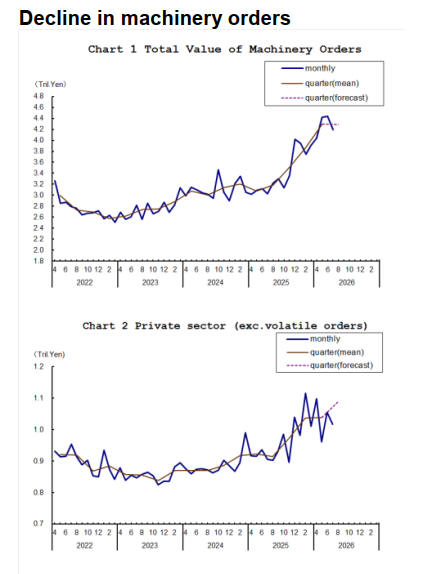
The total value of machinery orders (an indicator of
economic prospects) received by 280 manufacturers
operating in Japan decreased by 5.5% in July from the
previous month on a seasonally adjusted basis. Private-
sector machinery orders, excluding volatile ones for ships
and those from electric power companies, decreased a
seasonally adjusted by 3.7% in July.
See: https://www.esri.cao.go.jp/en/stat/juchu/2026/2607juchu-
e.html
Price increases outpacing wage gains, - shrinking
household disposable income
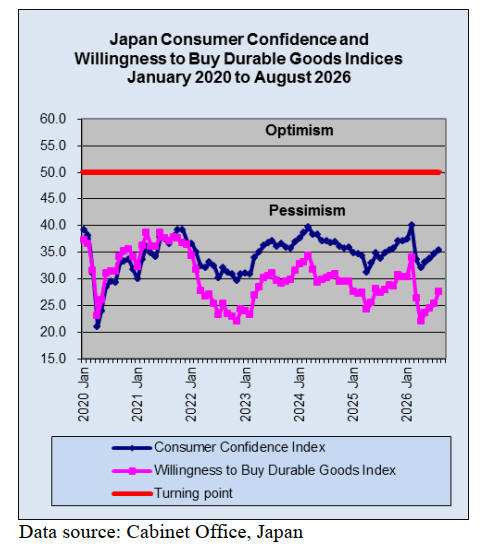
Japan's consumer confidence index consistently stays
below the neutral 50-point mark because persistent
inflation, historically sluggish wage growth and deep-
seated deflationary mindsets create chronic pessimism
among households. Decades of economic stagnation
(known as the "Lost Decades") fostered a deeply ingrained
cautious mindset regarding future economic security,
employment stability and national prosperity.
Recent price increases for imported energy, food and daily
necessities have begun to outpace wage gains, directly
shrinking household disposable income and depressing
views on overall livelihood.
Consumer sentiment has a direct impact on household
furniture purchases. Furniture is classified as a durable
good in Japan’s consumer confidence index. When
consumer sentiment is weak, households instinctively
delay purchases of high priced items. This dynamic
continues to drive trends in the furniture industry.
When consumers lack confidence in future income growth
they treat furniture as a non-essential item. Very often
instead of buying new pieces for aesthetic reasons
households hold onto their current furniture significantly
longer, reducing aggregate sales volumes.
Prolonged and low consumer confidence has polarised the
market. Traditional, premium craftsman manufacturers
have struggled as shoppers heavily favour budget-friendly,
value-driven alternatives. Economy-scale retailers have
captured major market shares by offering functional,
minimalist pieces at competitive prices.
Trends in furniture purchases are also compounded by
structural issues. Japan's low birth rate and aging
population mean fewer young families are moving into
new homes, which is the traditional catalyst for massive
furniture spending. Elderly households rarely replace large
furniture items unless absolutely necessary.
Despite depressed overall consumer confidence the
Japanese furniture market has not collapsed, instead, it has
adapted via three major trends:
Remote work and home improvement: The
normalisation of hybrid work has sustained
baseline demand for ergonomic office chairs and
compact home desks.
E-Commerce shift: Traditional brick-and-mortar
furniture stores face lower visitors but online
furniture sales are scaling up due to the
convenience and price-comparison capabilities of
digital platforms.
Sustainability focus: Consumers who do buy
furniture increasingly favor eco-friendly or high-
durability items made from local timber, viewing
it as a safer, lifetime investment rather than
disposable décor.
See: https://www.esri.cao.go.jp/en/stat/shouhi/shouhi-e.html
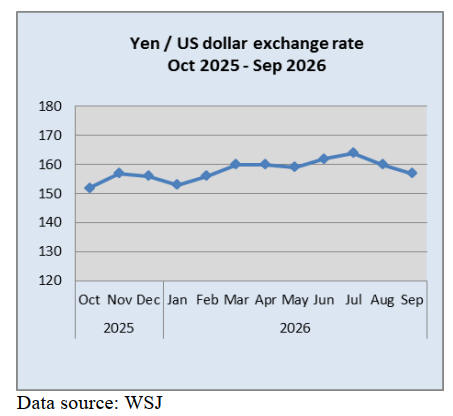
Some anticipate recovery to 150 to the US dollar
In late September the USD/JPY exchange rate was around
157. With the yen showing signs of recovery, analysts are
starting to anticipate the next target level. Some see ¥152
to the dollar and even ¥150 such as Goldman Sachs who
have revising their year-ahead target toward 150 as
potential pension fund inflows and shifting Japanese
monetary policies support the yen.
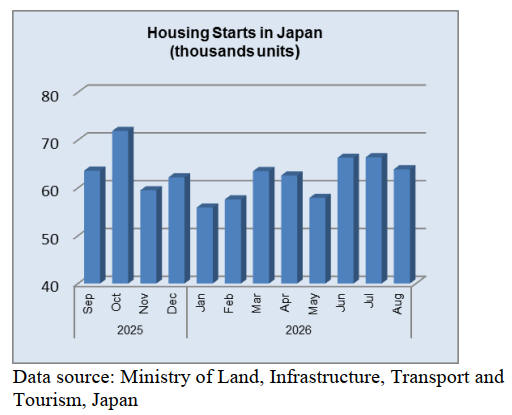
Ultra-long mortgages driving home buying by young
Japanes
Rising interest rates and record-high property prices have
not stopped young Japanese from buying a home, instead,
they are taking advantage of ultra-long mortgages of up to
40 and 50 years. While higher borrowing costs create
financial pressures, homeownership rates among young
households have actually reached record highs. The
homeownership rate for households headed by someone
under 30 reached over 40%.
Japan's Financial Services Agency (FSA) has stepped up
scrutiny on 50-year loans, examining whether banks are
properly assessing borrower income prospects and the
long-term repayment risks if interest rates rise or incomes
fall.
See: https://japan-forward.com/young-homebuyers-rising-rates-
ultra-long-mortgages/
and
https://www.japantimes.co.jp/business/2026/09/15/fsa-real-
estate-lending/
Import update –assembled wooden flooring and
plywood
Activity in the real estate and construction sectors is the
primary driver of Japan’s imports of wooden flooring and
plywood. The construction sector accounts for over 40%
of Japan's total wood market.
Single-family detached houses in Japan traditionally
utilise the "post & beam" (or Western "2x4") platform-
frame systems. Plywood is heavily consumed in these
projects as structural underlay for walls, roofing and
subflooring. Beyond new builds, the shifting preferences
in Japan's real estate market toward Western-style interiors
have fuelled a transition away from traditional tatami mats
toward assembled (multi-layer or engineered) wooden
flooring.
Assembled wooden flooring
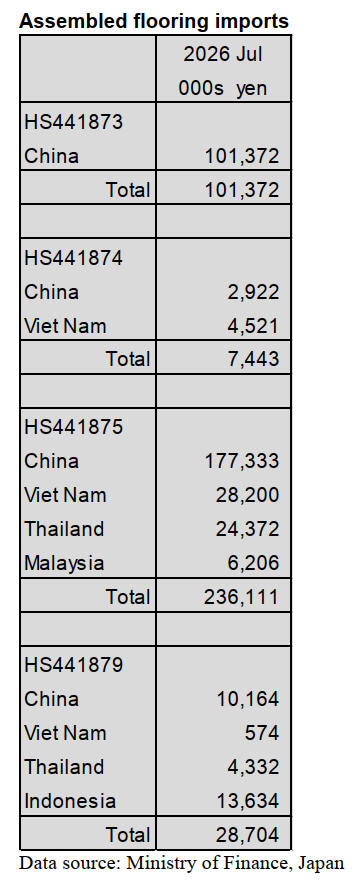
In July 2026, shippers in China accounted for all of
HS4418-73 imports the value of which was 40% higher
than in June. The value of July imports of HS4418-73
accounted for 27% of total assembled flooring imports
(21.5% in June). The value of HS441874 imports in July
2026 was down 13% from a month earlier extending the
decline seen in June. China and Viet Nam were the main
shippers but arrivals from shippers in China were down
compared to a month earlier.
Of the various categories of assembled flooring
imports,
HS441875 was the largest accounting for 63% of all
assembled flooring imports (72% in June). In July, arrivals
were only from shippers in China and SE Asia whereas in
June there were shipments from Europe. July is the
holiday period in Europe and most companies stop
production and exports.
HS441879 accounted for 8% of total imports in July (4%
in June) and were more than double the value of June
arrivals with shippers in China and Indonesia seeing
significant increases.
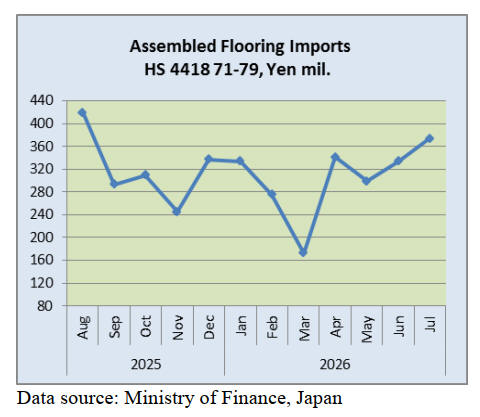
Year on year, July 2026 imports of assembled flooring
(HS441871-79) were up 7% and compared to a month
earlier.
Plywood imports
Over the past few years Japan's plywood sector has shifted
to increased domestic log utilisation for plywood
manufacturing at a time when supply from traditional SE
Asian exporters has declined. Japan's plan for the forestry
sector prioritise domestic roundwood, targeting an
increase in deliveries to processing and plywood mills
(aiming for 21 million cubic metres by 2030).
In the first half of 2026 SEt Asian producers have raised
export prices to offset rising production costs. Malaysia
and Indonesia remain principal hardwood plywood
suppliers however Japanese importers now practice tighter
inventory management.
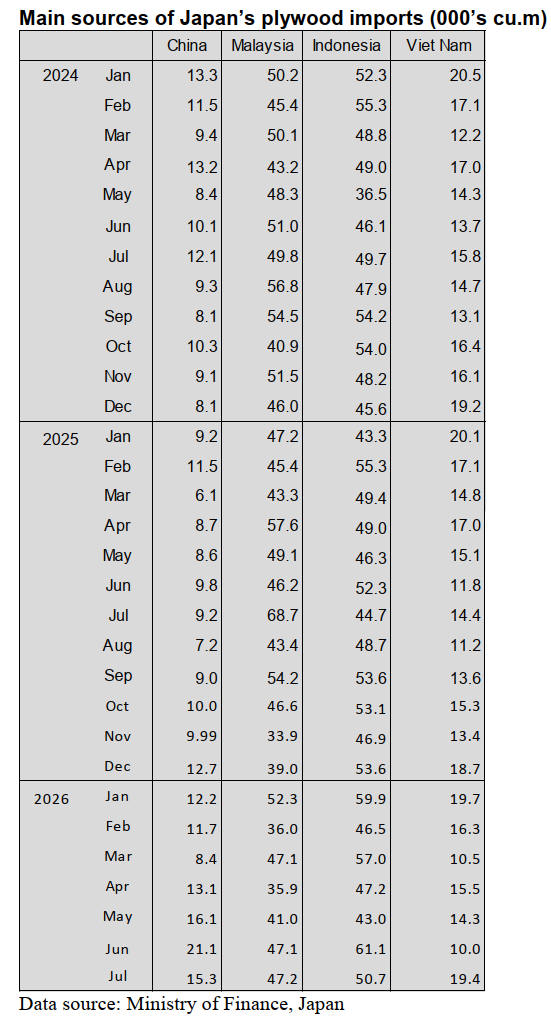
In July, as has been the case for many years, the top
suppliers, Indonesia and Malaysia accounted for most of
Japan’s plywood imports (over 70% in July) but shippers I
China are taking a larger market shrare.
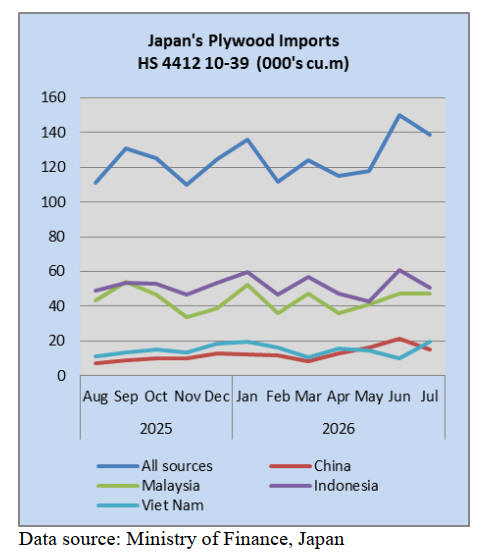
The volume of plywood imports in July 2026 was down
55% year on year and there was a 5% decline compared to
the volume of June imports. Month on month, there was a
16% decline in the volume of arrivals from Indonesia,
with import volumes from Malaysia staying at around the
same level as in June.
July import volumes from China were down 29% after
the
31%increase in June and import volumes from shippers in
Viet Nam more than doubled.
In July 2026 arrivals of HS441210-39 were reported at
138.681 cu.m (149,950 cu.m in June). As in previous
months, of the various categories of plywood imported in
July 2026, HS4412-31 accounted for 80% (79% in June)
followed by HS4412-39, 7% (7% in June), HS4412-34 6%
(6% in June) with the balance being HS4412-10 and
HS4412-33.
Trade news from the Japan Lumber Reports (JLR)
The Japan Lumber Reports (JLR), a subscription trade
journal published every two weeks in English, is
generously allowing the ITTO Tropical Timber Market
Report to reproduce news on the Japanese market
precisely as it appears in the JLR. For the JLR report
please see: https://jfpj.jp/japan_lumber_reports/
Volume of North American lumber in the first half of
2026
North American lumber arrivals in the first half of 2026
totaled 352,973 cbms, down 16.3% year-on-year and the
lowest level since U.S. lumber imports peaked.
All major species declined—SPF, Douglas fir and
hardwood—reflecting sluggish housing starts and the
persistently weak yen. Canada supplied 328,579 cbms
(down 12.9%), while U.S. shipments dropped sharply to
24,394 cbms, a 45.0% fall that stood out despite the small
absolute volume.
SPF arrivals improved in June to 53,436 cbms, returning
above the 50,000-cbm mark, though shipments remained
subdued through the first four months and only modestly
recovered in May.
Starts for 2×4 homes rose 1.5% to 43,817 units in
January–June, leaving the sharp decline in imports
difficult to explain given steady construction activity.
Among U.S. species, yellow cedar posted a slight 2.9%
increase to 1,931 cbms, while Sitka spruce plunged 54.5%
to 1,030 cbms.
Volume of North American logs in the first half of 2026
U.S. log imports in January–June 2026 fell 20.9% to
656,107 cbms, the lowest level since past peaks, with both
U.S. and Canadian shipments declining—particularly
Canada. Douglas fir dropped 21.2%, hardwood logs also
fell and plywood-grade Douglas fir showed notably weak
demand.
Import costs rose sharply as freight rates surged after
Middle East tensions, domestic sawmills raised prices and
U.S. production-region log prices climbed, adding over
¥4,000 per cbm. Higher U.S. duties on Canadian softwood
lumber further tightened supply and pushed West Coast
Douglas fir prices up.
Although Canadian plywood-grade logs remained stable at
origin, freight costs and the weak yen lifted import costs to
around ¥34,000 per cbm. Yen appreciation after joint
intervention reduced costs by less than ¥1,000 per cbm
and trading firms note that competitiveness will not return
unless costs fall below ¥30,000 per cbm.
South Sea logs and lumber
Prices for imported hardwood products remain elevated.
Although coordinated currency intervention by Japan and
the United States pushed the yen into the ¥150 range in
late July, the appreciation has not been sufficient to
significantly reduce import costs.
The sudden swing in exchange rates has also made some
domestic buyers more cautious about placing new orders.
Supply of tropical hardwoods has tightened as log
harvesting volumes decline at the origin, making it
difficult for manufacturers to secure logs for Japan bound
production. While log procurement for Japan requires
additional time, a sizable shipment from Papua New
Guinea is expected toward year-end.
Other producing regions continue to ship sawlogs via
container transport.
Domestic tropical hardwood sawmills report that they
have secured adequate log inventories and supply–demand
conditions remain balanced. Prices for tropical hardwood
and China-made products at the origin remain high due to
log shortages and rising costs at local sawmills. Domestic
buyers, meanwhile, have become increasingly cautious, as
the combination of high origin prices and the yen’s
appreciation in late July has made procurement decisions
more difficult.
Double-digit growth in wood-pellet imports
Imports of wood-based fuel in the first half of 2026
(January–June) totaled 8.133 million tonnes, up 7.7% from
the same period a year earlier, combining wood pellets and
PKS. The increase is believed to reflect rising demand as
large biomass power plants that came online in 2024 and
2025 began full-scale procurement of fuel.
Large biomass plants that have come online in recent years
rely heavily on wood pellets as their primary fuel,
resulting in pellet growth outpacing that of PKS. Wood
pellets offer relatively uniform quality and are easier to
handle in terms of transport, storage and combustion
control.
PKS also saw increased procurement, both as a
complementary fuel alongside pellets and because prices
in Indonesia—its main production region—temporarily
declined, making it a cost-effective option.
Imports of wood pellets in the first half of 2026 totaled
4.524 million tonnes, up 10.3% from a year earlier. By
major origins, Viet Nam—accounting for more than half
of total imports— supplied 2.951 million tonnes, an 11.1%
increase year on year. Canada followed with 597,000
tonnes (down 5.7%), Malaysia with 319,000 tonnes (up
28.3%), the United States with 280,000 tonnes (down
1.4%) and Indonesia with 250,000 tonnes (up 16.4%).
Imports of PKS in the first half of 2026 totaled 3.609
million tonnes, up 4.7% from a year earlier. By origin,
Indonesia supplied 2.802 million tonnes (a 7.4% increase), Malaysia
764,000 tonnes (down 4.8%) and Thailand 42,000 tonnes
(up 19.3%).
|


