|
1.
CENTRAL AND WEST AFRICA
Unusual and contrasting weather conditions
Central African countries are experiencing unusually
contrasting weather conditions as September comes to an
end. Gabon and large parts of central and southern Congo
continue to experience an exceptionally prolonged dry
period. In some areas, meaningful rainfall has been absent
for several months, with only occasional light drizzle
reported. It is anticipated that these unusually dry
conditions could continue until year end.
Conditions are very different in northern Congo and much
of Cameroon, where very heavy rainfall is affecting
harvesting, trucking and the movement of timber to ports.
Further east, towards areas closer to Chad, conditions are
again considerably drier, with agricultural production
reportedly suffering from the lack of rainfall. The
unusually divided weather pattern is having a direct
impact on forest operations and regional logistics.
Cameroon
Heavy rainfall continues to disrupt Cameroon's forestry
sector. Harvesting is being delayed, forest roads are
becoming increasingly difficult to use and trucking times
are extending. Port congestion is also contributing to
longer shipment schedules, creating delays throughout the
supply chain.
Sawmill activity remains cautious
Production slowdowns are being caused partly by rainfall
and partly by the weakness of international markets. Mills
are avoiding unnecessary stock accumulation and are
concentrating more closely on confirmed orders.
Timber export prices remain broadly stable, although
some species are experiencing downward pressure from
Chinese buyers. This remains a familiar feature of the
market whenever purchasing activity from China weakens.
International market conditions
The wider markets for African wood products remain
difficult, with China, Europe and the Middle East all
showing relatively subdued demand. Middle East demand
remains slow particularly for traditional red species such
as Iroko, Sapelli and other redwoods.
Cameroonian exporters remain increasingly concerned
about the cost and administrative burden of supplying
Europe. EUTR requirements continue to demand detailed
traceability from the forest through harvesting, transport,
sawmilling and export. Producers are also preparing for
the forthcoming EUDS framework, which is expected to
place further requirements on exporters.
Gabon
Gabon continues to experience unusually dry conditions,
good for forest operations but activity in the industry
remains slow for most species with Okoumé particularly
affected. The Okoumé peeling sector continues to contract
due to the collapse of Indian demand and strong
competition from Chinese producers.
A significant number of peeling mills remain closed or
are operating at reduced capacity.
On a more positive note, an established Chinese operator
is reportedly developing a new sawmill in southern Gabon.
The project includes approximately 4,000 square metres of
solar installation, reflecting the increasing need for
industrial operators to secure independent and reliable
power supplies.
Infrastructure projects
Several major infrastructure projects continue to face
delays as available funding falls short of expectations.
Financing has reportedly been lower than originally
anticipated and this is creating difficulties for the
government as it attempts to progress major road, rail and
port projects.
The Tchibanga road project is one example where
financing to surface approximately 96 kilometres of road
has been delayed. The same also is said to apply to
sections of the national road between Tchibanga and
Ndendé near the Congolese border. Competing road and
port infrastructure developments are placing considerable
pressure on public finances.
Port of Owendo
Port operations at Owendo remain generally normal and
transport between Libreville and the port is functioning
without major difficulty. However, recently vessel
congestion has becoming more noticeable, with ships
waiting several days before berthing.
Re-introduction of Kevazingo
Several years ago Gabon authorised exports of Kevazingo
but the international market for this species remains
considerably weaker than in previous years. Earlier export
restrictions significantly reduced international trading
activity, while demand from the furniture industry has also
weakened.
Current market indications suggest that prices for
Kevazingo used in furniture applications have fallen by as
much as approximately 50% compared with earlier market
levels. As a result, the reopening of exports is considered
unlikely to generate an immediate return to the volumes or
prices previously associated with the species.
Republic of Congo
The Republic of the Congo is experiencing many of the
same market difficulties as neighbouring producers.
Exports of sawn timber are declining as Chinese and
Philippine purchasing remains weak. Sawmills are
therefore increasingly attempting to develop alternative
markets, including Europe and South America.
Malaysian-operated peeling factories are also reportedly
reducing their purchases of Okoumé because of weaker
demand in both China and Europe. Fortunately for the
country's wider economy, Congo continues to benefit from
its oil and mineral resources.
With traditional Asian markets subdued, Congolese
sawmills are increasingly looking towards Europe and
emerging South American destinations. However,
exporters supplying Europe continue to face increasingly
demanding EUTR requirements and preparations for the
forthcoming EUDR framework. These regulatory
requirements are influencing market strategy across the
entire region and are encouraging mills to diversify
geographically.
Europe and African timber trade
The increasingly complex regulatory environment remains
one of the principal concerns for Central African timber
producers. European due-diligence requires detailed
documentation covering timber from the original forest
concession through harvesting, transportation, processing
and final export. The updated EUDR has elaborated these
requirements further.
Regional producers argue that the additional costs,
administrative requirements and compliance risks
associated with selling to Europe are making other
international markets increasingly attractive.
Sawmill production
Sawmill production remains below potential capacity. The
primary constraint is not machinery or labour availability
but weak international demand. Mills are therefore
carefully controlling output and avoiding unnecessary
accumulation of sawn timber stocks.
China, traditionally one of the most important markets for
Congolese timber, continues to purchase cautiously. The
wider regional market has also seen Chinese buyers
putting pressure on export prices, particularly as
inventories remain relatively high and purchasing
requirements have weakened.
Philippine orders have also declined, particularly for
Okoumé, reducing one of the traditional outlets for
southern Congolese producers.
Alternative export markets
The weakness of traditional Asian destinations is
encouraging producers to diversify. South America is
emerging as an increasingly interesting destination for
selected African hardwoods. Although volumes remain
relatively small compared with traditional Chinese and
European markets, these new destinations could become
important if Asian purchasing remains subdued and
European regulatory requirements continue to increase.
This broader diversification strategy is becoming more
visible across Congo, Gabon and Cameroon.
Overall market outlook
The West and Central African timber market remains
under considerable pressure entering October. Demand in
China remains subdued, the Philippines is purchasing
cautiously and the Middle East continues to offer limited
opportunities. European demand remains available for
selected species but is increasingly constrained by freight
costs and regulatory requirements.
Producers are therefore continuing to develop alternative
markets in South America, Asia and other regions.
Weather will also remain a major factor. Heavy rainfall in
Cameroon and northern Congo is restricting harvesting
and transport, while the prolonged dry conditions in
Gabon and southern Congo continue to provide relatively
favourable operational conditions.
Export prices remain broadly stable but underlying market
sentiment is weak. The central challenge for producers is
increasingly shifting from the ability to harvest timber
towards finding reliable, commercially attractive markets
capable of absorbing production.
Through the eyes of industry
The latest GTI report lists the challenges identified by the
private sector in the Republic of Congo and Gabon.
See:
https://www.itto.int/direct/topics/topics_pdf_download/topics_id
=596778&no=1
2.
GHANA
Sliced veneer exports declined
According to the Timber Industry Development Division
(TIDD) of the Forestry Commission, Ghana’s wood
product exports recorded an overall decline in the first
seven months of 2026 compared to the same period in
2025. Total export volume fell by 8% from 126,980 cu.m
to 116,355 cu.m, while export earnings dropped by 13%
year-on-year.
Rising domestic demand is absorbing an increasing share
of available timber in Ghana but it is only one of several
factors driving the decline in exports. Decades of
deforestation, illegal logging and shrinking forest cover
have significantly reduced the overall growing stock and
availability of commercial timber species.
While demand in traditional markets has waned due to
strict regulatory and legal compliance standards, regional
ECOWAS demand has grown and a substantial portion of
unrecorded or informal trade moves through overland
channels and this is often not captured in global export
statistics.
Urbanisation, construction and local manufacturing
demands have increased, meaning a larger volume of
harvested timber stays within the domestic market instead
of being shipped overseas.
See: https://ndfwestafrica.org/wp-
content/uploads/2025/07/Overland-export-of-timber-from-
Ghana.pdf
and
https://www.fao.org/4/AB567e/ab567e02.htm
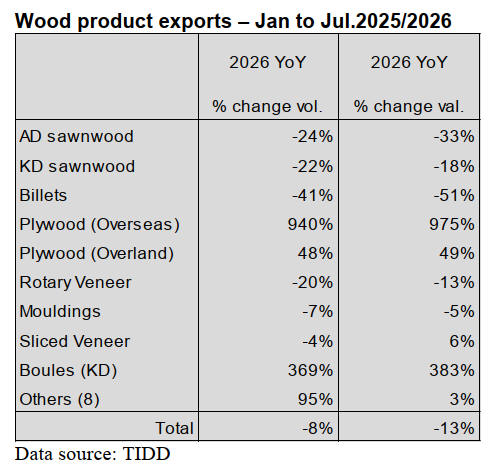
The overall decline in the period Jan.-Jul. 2026 was
largely driven by reduced shipments of the major products
which included billets and sawnwood. Air dry sawnwood
remained the main export product, accounting for 49% of
the total export volume for the period. But export volumes
fell 24% to 56,451 cu.m and by 33% in value. The share of
total exports also declined from 58% to 49%.
Kiln dry sawnwood exports also dropped by 22% in
volume to 14,363 cu.m. Billet exports saw the sharpest
decline among traditional products, down 41% in volume
and 51% in value. Rotary veneer and moulding exports
also contracted by 20% and 7% respectively.
In contrast to the overall downturn, plywood and specialty
products recorded strong growth. Plywood exports outside
of the region surged to 13,263 cu.m and its share of total
export volumes rose from 1% to 11% compared to the
same period in 2025. Plywood exports to regional markets
increased 48% to 12,623 cu.m. Exports of boules and
“Others” also grew significantly, albeit from a low base.
Sliced veneer exports had a mixed performance with
export volumes dropping 4% but export value rising 6%.
The leading species for sliced veneer export were
asanfina/anigre (1216 cu.m), koto/kyere (583 cu.m),
sapele (493 cu.m), ceiba (323 cu.m) and chenchen (314
cu.m) which together account for 75% of the total sliced
veneer export for the period valued at Eur 4.00 million.
Twenty one (21) other species contributed to the
remaining 25% of the export volume. Table shows the
average unit price of these species ranging from
Eur832/cu.m to Eur1,742/cu.m.
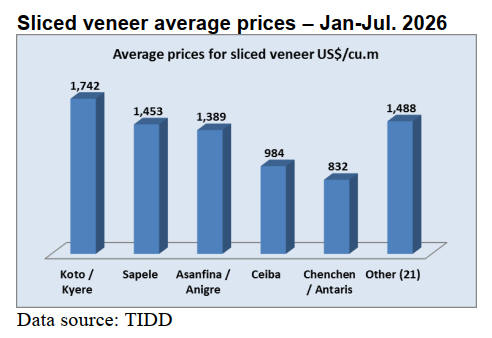
Koto/kyere recorded the species with highest average unit
price of Eur1,742/cu.m) for the period and chenchen the
least (Eur832/cu.m). Major market destinations were Italy,
Germany, USA and India.
Reserve shrinks by 1.5 months import cover
Ghana’s international reserves had fallen to US$11.1
billion at the end of August 2026, down from US$14.16
billion in March, reducing import cover to 4.2 months and
raising concerns about the country’s external position.
Despite recording a US$8.8 billion trade surplus and a
US$5.1 billion current account surplus in the first half of
2026 the decline in reserves has weakened Ghana’s
foreign exchange buffer and could pose challenges if
demand for foreign currency increases in the final quarter
of the year.
In other news, the cedi has come under pressure,
depreciating 9.5% against the US dollar during the first
nine months of 2026, as well as 9.0% against the pound
and 7.3% against the euro.
The Bank of Ghana’s Monetary Policy Committee (MPC)
kept the policy rate at 14% for a third consecutive
meeting, citing a balanced outlook for inflation and
growth. This decision followed a rise in inflation from
4.6% in July to 5.0% in August 2026.
On the economic front, AGI President Dr. Kofi Nsiah-
Poku praised Finance Minister Dr. Cassiel Ato Forson for
the Ministry’s efforts to restore economic stability.
However, Ghana’s public debt increased to GHc733.9
billion in July 2026, rising by GHc13.1 billion over two
months and GHc92 billion since December 2025,
highlighting ongoing fiscal pressures.
See: https://www.myjoyonline.com/ghanas-reserve-buffer-
shrinks-to-4-2-months-as-bog-flags-fresh-external-risks/
and
https://www.myjoyonline.com/cedi-depreciation-hits-9-5-as-
renewed-fx-pressure-weighs-on-currency/
Opposition to gravel mining plans for road projects
Environmental advocacy coalition Weto Platform has
expressed alarm about gravel mining activities associated
with the development of borrow pits along the Akwapim-
Togo Mountain Range to supply materials for roads being
constructed under the ‘Big Push’ initiative.
The Government’s’ Big Push’ initiative, is President
Mahama’s flagship road infrastructure programme to
promote the industrial and economic growth of the
economy.
The Coordinator of the Weto Platform, Pascal Benson
Atiglah, explained that ongoing excavation activities by
contractors and individuals around Anyirawaes in the Ho
West District of the Volta Region and Santeokodi in the
SALL District of the Oti Region have caused serious
environmental damage.

Through the eyes of industry
The latest GTI report lists the challenges identified by the
private sector in Ghana.
See:
https://www.itto.int/direct/topics/topics_pdf_download/topics_id
=596778&no=1
3. MALAYSIA
Exports for the first eight months of 2026 grew over
30%
The encouraging export performance demonstrates that
Malaysia’s strategy to market and product diversification
over recent years has started to bear fruit despite the
uncertainties in global trade. Malaysia’s exports for the
first eight months of 2026 grew 31% to RM1.356 trillion,
compared with RM1.033 trillion in the same period last
year.
Exports to 40 countries, including the United States,
France and Ireland, had already surpassed their full-year
export values recorded in 2025. Exports to emerging
markets also recorded significant growth, led by Namibia
with a 430% increase followed by Angola at 215%,
Ethiopia at 51%, Tanzania at 50% and Bangladesh at 20%.
See:
http://theborneopost.pressreader.com/article/282265262340096
Port Klang Authority proposing further increases in
charges
Port Klang, the biggest port in Malaysia and one of the
world’s top 15 busiest ports has proposed increasing port
charges. Port Klang handles between 13 to 14 million
TEUs a year.
The Federation of Malaysian Manufacturers (FMM) is
urging the Port Klang Authority (PKA) to retain the
current RM20 minimum warehouse handling charge for
small consignments. The charges were last reviewed in
2015. Under the new proposal the charge for handling
LCL cargo (less than container load) at warehouses would
rise from RM12 to RM16.50 per tonne. The minimum
charge would go up from RM20 to RM30. Other charges
such as storage, overtime work, cargo surveys and
carpentry services would rise by 30%.
For freight forwarding services, the terminal-handling
charge is proposed at RM60 per cubic metre, up from
RM55. The declaration charge would rise from RM30 to
RM35 for each house bill of lading, while the
documentation charge would increase from RM170 to
RM227 for each delivery order.
Besides the minimum charge increasing to RM30, the
proposed rise in cargo-handling charges at warehouses is
37.5%, so the rate would go up from RM12 to RM16.50
per tonne. FMM is also concerned about a proposal to
raise the less-than-container-load (LCL) cargo terminal-
handling charge to RM60 per cubic metre. The proposed
RM60 rate would be 11% higher than the current rate and
9% higher than the scheduled 2027 rate.
FMM has questioned the need for another revision before
the existing phased increase has been fully implemented
and its impact assessed, said FMM. FMM said the higher
charge would affect manufacturers that bring in small and
frequent shipments of raw materials, components,
machinery parts and urgent replacement items.
“SMEs and manufacturers producing specialised or lower-
volume products would be more exposed because they
have fewer opportunities to consolidate shipments and
spread logistics costs across larger cargo volumes,”
according to FMM.
See: https://www.thestar.com.my/news/nation/2026/09/22/extra-
costs-may-be-passed-on-to-consumer
and
https://www.thestar.com.my/news/nation/2026/09/22/small-
shipments-bigger-charges
Plywood the top export from Sarawak
The export value of timber and timber-based products
from Sarawak is estimated to have reached RM1.16 billion
as of June this year, said Sarawak Timber Industry
Development Corporation (STIDC) General Manager,
Zainal Abidin Abdullah. He said the export value was
lower than the RM1.21 billion recorded during the same
period last year due to challenges stemming from market
prices, product value and changing international market
conditions.
“Plywood remained the main contributor, with an export
value of more than RM500 million, followed by logs at
about RM192 million,” he said. Downstream products also
contributed to the overall export value, earning RM200
million during the same period.
He noted that the Sarawak government had stopped
issuing logging licences since 2014. At the same time, he
said, the government issued licences such as industrial tree
plantation (ITP) licences for reforestation aimed at
maintaining environmental sustainability while ensuring a
continuous supply of raw materials for the state’s
downstream timber industry.
See:
http://theborneopost.pressreader.com/article/282243787497782
Agarwood woodchip exports around 95,000kg last year
Malaysia should move beyond exporting raw agarwood
and focus on turning the fragrant commodity into higher-
value products, says Plantation and Commodities Minister,
Dr. Noraini Ahmad. She said Malaysia had a strong
foundation to develop the industry with more than two
million karas (Aquilaria) trees planted nationwide.
Dr. Noraini said growing demand for agarwood (also
known as oud or gaharu) presented opportunities for local
entrepreneurs to move up the value chain through products
such as agarwood oil, perfumes, personal care products,
handicrafts, souvenirs and other lifestyle products.
Malaysia’s agarwood woodchip exports reached almost
95,000kg worth RM11.4 mil. last year, reflecting the
commodity’s growing market.
Dr. Noraini also stressed the importance of developing the
agarwood and timber industries responsibly with buyers
increasingly concerned about the source of products and
how they are produced.
She said agarwood traded under the Convention on Inter-
national Trade in Endangered Species of Wild Fauna and
Flora must be accompanied by valid documentation and
permits. Karas growers and agarwood processors must
also be registered with the Malaysian Timber Industry
Board, she added.
See: https://www.thestar.com.my/news/nation/2026/09/14/time-
to-turn-agarwood-exports-into-premium-products
Harvesting deferred – trade uncertainties and rising
costs
Timber companies are reacting to the headwinds caused
by the war in Middle East and global trade disruptions.
One example is a company in Sabah which has deferred
harvesting activities under its Industrial Tree Planting
Agreement with a subsidiary of the Yayasan Sabah Group.
The company said the decision followed a review of
prevailing operating and market conditions, including the
increase in diesel prices and overall operating costs.
See: https://www.thestar.com.my/business/business-
news/2026/09/22/focus-lumber-defers-harvest-to-next-year
Through the eyes of industry
The latest GTI report lists the challenges identified by the
private sector in Malaysia
See:
https://www.itto.int/direct/topics/topics_pdf_download/topics_id
=596778&no=1
4.
INDONESIA
Indonesian furniture potential in
India
Indonesian furniture products generated potential
transactions worth Rp39.7 billion (US$2.26 million) at the
INDEXPLUS 2026 exhibition in New Delhi, India,
according to the Ministry of Trade.
Four Indonesian businesses participated in the exhibition
presenting furniture that combines contemporary designs,
skilled craftsmanship, premium materials and Indonesia’s
cultural heritage. Indonesian trade representatives in India
pledged to support export expansion through business
matching and trade facilitation.
Indonesian furniture products are recognised in India for
their quality craftsmanship and natural aesthetic appeal.
Compliance with legality and sustainability standards
through the Timber Legality and Sustainability
Verification System (SVLK) certification strengthens
buyer confidence and adds value to Indonesian exports.
To improve market competitiveness, Indonesian exporters
are encouraged to utilise tariff benefits under the ASEAN-
India Free Trade Area (AIFTA).
See: https://en.antaranews.com/news/430961/indonesian-
furniture-recorded-rp397-billion-in-potential-india-sales
and
https://rri.co.id/en/business/2722512/indonesian-furniture-draws-
usd-226-million-potential-deals-in-india
Making furniture and craft industries a key economic
driver
The Indonesian Furniture Industry and Craft Association
(HIMKI) has launched a Grand Strategy Plan (GSP) to
strengthen the competitiveness of Indonesia’s furniture
and handicraft industry and establish it as a key pillar of
the national economy.
Announced as one of the outcomes of HIMKI’s fourth
National Congress in Bali on 15 September 2026, the GSP
was developed in collaboration with the government,
industry associations and other stakeholders. It focuses on
strengthening the domestic market, increasing exports,
promoting design and innovation, developing skilled
human resources, expanding access to sustainable raw
materials and enhancing Indonesia’s position in the global
furniture and handicraft value chain.
Through the GSP, HIMKI seeks to coordinate policies and
cooperation among government institutions, businesses,
designers, artisans, financial institutions, universities,
exhibition organizers and international partners. The
initiative aims to move Indonesia beyond supplying raw
materials and manufactured goods toward becoming a hub
for high-value-added furniture and handicraft design,
production and trade.
See:https://m.antaranews.com/amp/berita/5743224/himki-bidik-
industri-mebel-kerajinan-jadi-kekuatan-ekonomi-lewat-gsp
and
https://surabaya.tribunnews.com/bisnis/1949993/himki-tegaskan-
gsp-dorong-ekspor-dan-inovasi-industri-
kerajinan#goog_rewarded
Financing challenges in pursuit of US$6 billion
furniture export target
Indonesia’s furniture and handicraft industry is targeting
export revenues of around US$6 billion by 2031 but
access to financing remains a major challenge. HIMKI
Chairman, Abdul Sobur, said adequate working capital is
needed for businesses to increase production capacity and
fulfill larger export orders. The challenge is particularly
significant for small and medium-sized companies which
can experience cash flow problems in the absence of
financing options.
HIMKI is urging the Indonesia Export Financing Agency
(LPEI) to provide faster and more affordable financing
based on purchase orders, contracts and export
receivables, supported by guarantees and export insurance.
Sobur also called for financing to be extended beyond
large exporters to small and medium companies through
an aggregator scheme, allowing funds to reach material
suppliers and manufacturers throughout the export supply
chain.
See:
https://ekonomi.bisnis.com/read/20260920/257/2005599/bidik-
target-ekspor-us6-miliar-industri-furnitur-terganjal-modal-seret
Machinery modernisation in forest product sectors
The Ministry of Industry is promoting machinery and
equipment modernisation in the forest products and
plantation sectors through its 2026 Machinery and/or
Equipment Restructuring Programme for the Agro-
Industry Sector. Industry Minister, Agus Gumiwang
Kartasasmita, said the initiative aims to improve
productivity, efficiency, production capacity and
competitiveness while strengthening Indonesia’s industrial
ecosystem from upstream to downstream.
He also emphasised that modernising production
equipment should support a stronger national industrial
structure, increase added value and build a more resilient
industry.
Acting Director General of Agro-Industry, Putu Juli
Ardika, highlighted the importance of technological
modernisation and product diversification to sustain
business operations amid market competition.
Meanwhile, Acting Director of Forest Products and
Plantation Industries, R.R. Citra Rapati, said the
programme encourages businesses to adopt modern
technologies to improve production efficiency, increase
capacity and productivity and enhance product quality.
These improvements are expected to generate greater
added value for the forest products and plantation
industries.
See: https://suarapemerintah.id/2026/09/kemenperin-dorong-
modernisasi-mesin-industri-hasil-hutan-dan-perkebunan/
Carbon and Biodiversity Summit 2026 advances green
economy development
The Association of Indonesian Forest Concession Holders
(APHI) is supporting the Indonesia Carbon and
Biodiversity Summit 2026 in collaboration with the
Indonesia Carbon Credit and Biodiversity Alliance
(ICBA) to promote the development of Indonesia’s carbon
and biodiversity economies.
APHI Chairman, Soewarso, said forestry businesses have
an important role in realising government policies with
implementation on the ground, particularly in carbon
management and biodiversity conservation.
APHI’s priorities include regulatory and business
certainty, carbon market integrity, integrated carbon and
biodiversity management, community participation and
landscape-based collaboration. He also stressed the
importance of reliable data and transparent measurement,
reporting and verification throughout carbon projects to
strengthen market confidence.
APHI also promotes a multi-business forestry approach
that integrates carbon management with biodiversity
conservation, environmental services, non-timber forest
products, agroforestry and ecotourism, while ensuring
communities participate in planning and benefit sharing.
ICBA Chairman, Rob Raffael, said APHI can help connect
forest managers with investors, carbon buyers, academics
and other partners, while bringing practical forest-
management experience to carbon projects.
The cooperation aims to support long-term partnerships
and innovative financing for credible carbon projects with
measurable environmental benefits and transparent
governance, while maintaining forests as a foundation of
Indonesia’s green economic development.
See: https://mediaindonesia.com/ekonomi/932158/indonesia-
carbon-and-biodiversity-summit-2026-perkuat-dukungan-untuk-
ekonomi-hijau
and
https://www.jpnn.com/news/aphi-bersama-icba-inisiasi-
penguatan-ekonomi-karbon-
biodiversitas?page=2#goog_rewarded
Indonesia and FAO launch ‘MERANTI’ project
Indonesia’s Ministry of Forestry and the Food and
Agriculture Organization (FAO) have launched a
Monitoring and Enhancement of Remote Sensing for
National Forest Inventory (MERANTI) project to
modernise the country’s forest monitoring system.
Supported by around US$5 million in funding from the
Norwegian Government the project aims to improve the
accuracy and reliability of forest data while reducing the
time required for collection through the National Forest
Inventory (IHN) 2.0 system.
The initiative is expected to expand coverage to hard-to-
reach areas, including coastal mangroves and community-
managed forests and strengthen data-based policymaking,
forest management and climate action.
Running from 2026 to 2028, MERANTI will combine
field data with satellite imagery to provide more
comprehensive information on Indonesia’s forest
resources.
The FAO will support field data collection across at least
500 National Forest Inventory (IHN / Inventarisasi Hutan
Nasional) clusters nationwide, gathering information on
forest species composition, biomass, degradation and soil
conditions that cannot be fully captured through satellite
monitoring alone. The project will also strengthen
government capacity in forest inventory implementation,
data analysis and quality assurance and control, supporting
more transparent and science-based forest management.
See: https://en.antaranews.com/news/430959/indonesia-fao-
launch-meranti-project-to-modernize-forest-monitoring
and
https://www.fao.org/indonesia/news/detail/ministry-of-forestry-
and-fao-launch-meranti-project-to-modernize-indonesia-s-forest-
monitoring--produce-better-data/en
Indonesia suspends corporate licenses amid wildfire
crackdown
The Minister of Forestry, Raja Juli Antoni, said the
ministry has suspended the operating licenses of 26
companies as part of a crackdown on those suspected of
creating forest and land fires.
The suspensions are administrative sanctions that may be
accompanied by environmental restoration requirements
and could lead to criminal prosecution if evidence of
wrongdoing is found. Antoni said the ministry is currently
handling 46 cases involving both companies and
individuals, stressing that enforcement efforts target both
parties and that cases containing evidence of criminal
violations will be taken to court.
In related news, the Ministry has revoked the business
licenses of five companies linked to forest and land fires,
their concessions cover a combined 92,464 hectares in
West, South and Central Kalimantan. The Minister said
the revocations were part of law enforcement against
companies that violated their obligations as Forest
Utilisation Business License (PBPH) holders, including
requirements to protect their concession areas and comply
with licensing conditions. The total burned area across the
five concessions reached 1,169 hectares.
See:https://en.antaranews.com/news/431516/indonesia-suspends-
26-corporate-licenses-amid-wildfire-crackdown
and
https://hijau.bisnis.com/read/20260922/651/2006073/kemenhut-
cabut-izin-5-perusahaan-terkait-karhutla-luas-konsesi-92464-
hektare.
EU leaders to visit Indonesia for IEU-CEPA talks
European Commission President, Ursula von der Leyen,
and EU Trade Commissioner Maroš Šefčovič are expected
to visit Indonesia in late October or early November 2026
as both sides work to finalise the long-negotiated
Indonesia-European Union Comprehensive Economic
Partnership Agreement (IEU-CEPA).
Coordinating Minister for Economic Affairs, Airlangga
Hartarto, said President Prabowo Subianto has instructed
his cabinet to accelerate the agreement’s completion,
which has entered its final administrative stage. Legal
teams are currently finalising the English-language text
before it is submitted to the European Parliament for
review, followed by ratification by Indonesia’s House of
Representatives (DPR). Indonesia aims to implement the
agreement by early 2027.
The IEU-CEPA is expected to expand market access,
increase bilateral investment and strengthen economic
relations between Indonesia and the European Union.
See: https://en.antaranews.com/amp/news/432348/eu-leaders-to-
visit-indonesia-for-ieu-cepa-talks-airlangga
Work started to extinguish forest fires in western
Kalimantan
Japan's Self-Defense Forces has started work to extinguish
forest fires in western Kalimantan, Indonesia. CH-47
helicopters started dropping water. According to Japan's
Defense Ministry, this is the SDF's first firefighting
operation outside of the country. The operation was first
delayed due to smoke from the fires reducing visibility.
The fire situation in Kalimantan started to worsen around
August, leading Indonesian authorities to seek support
from Japan under the two countries' defense cooperation
agreement.
See: https://www.nippon.com/en/news/yjj2026091601112/
Through the eyes of industry
The latest GTI report lists the challenges identified by the
private sector in Indonesia.
See:
https://www.itto.int/direct/topics/topics_pdf_download/topics_id
=596778&no=1
5.
MYANMAR
Market and governance outlook
Myanmar’s forestry and timber sector continues to face
weak international demand, high fuel costs, high freight
costs, foreign-exchange constraints and disrupted trade
routes. Forest Department reports show continuing
seizures of illegal teak and hardwoods. These
developments indicate continuing efforts on enforcement
but seizure data alone cannot establish whether illegal
logging is increasing or declining.
Internationally, the August Global Timber Index showed
contraction in most participating producer and consumer
countries, including several of Myanmar’s regional
markets.
Recent ASEAN forestry meetings emphasised legal and
sustainable supply chains, producer readiness, digital
traceability and higher-value products. Although
Myanmar’s access to EU markets is restricted the
approaching EUDR application of geolocation, source-
specific legality evidence, deforestation assessment and
consignment-level due diligence requires Myanmar’s
attention.
Myanmar’s existing forestry and trade controls provide the
technical foundation through the Myanmar Timber
Legality Assurance System (MTLAS) and Digitalised
Timber Tracking System (DTTS) but their credibility
depends on consistent law enforcement, field access,
reliable records and independent verification.
Weak enforcement does not make every consignment
illegal but it increases uncertainty and raises the level of
evidence expected from operators and buyers.
Legality and SFM assurance require reconciliation of
forest source, authorised harvest, transport, processing and
export records, together with evidence that AAC limits,
harvesting cycles, biodiversity safeguards and community
rights are observed.
See - https://forestdepartment.gov.mm/news/30306?utm_source
and
https://www.gnlm.com.mm/mnrec-designates-namsang-as-
protected-public-forest/?utm_source
MTE maintains monthly timber tender sales
Myanma Timber Enterprise (MTE) conducted regular
monthly open tenders from January through September
2026 for teak and hardwood logs and conversions. Tender
notices were issued through its Export Marketing and
Milling Department, indicating the continued availability
of timber from MTE depots, sawmills and other
designated storage locations.
Teak remained the dominant commercial material in both
log and conversion categories. Hardwood offerings were
considerably smaller and included species such as padauk,
pyinkado, inn, thitya and thingan.
The available schedules indicate notable monthly
fluctuations in the quantity of timber advertised. In July,
the gross advertised volume was approximately 1,094
Hoppus tons. This included about 6441 Hoppus tons of
logs, comprising 614 Hoppus tons of teak and 31 Hoppus
tons of hardwood. MTE also advertised approximately 398
Hoppus tons of teak and hardwood conversions, together
with 50 Hoppus tons of kiln-dried teak conversions under
a special tender.
The gross advertised volume declined to approximately
943.51 Hoppus tons in August. However, September
recorded a substantial increase to about 2,471 Hoppus
tons. The September total comprised approximately 739
Hoppus tons of logs offered under the regular tender, 3875
Hoppus tons of regular conversions, 1,244 Hoppus tons of
special log offerings and 99 Hoppus tons of kiln-dried
conversions.
This increase was driven principally by a large special
teak-log offering, including approximately 1,039.57
Hoppus tons located at Kantbalu. The September volume
was therefore more than twice the July offering and
approximately 162% higher than the August total.
The increase should nevertheless be interpreted cautiously.
Examination of the tender schedules indicates that
repeated or closely similar lots appeared in different
months. This may mean that some timber remained
unsold, was withdrawn, carried forward or reoffered in
subsequent tenders.
The monthly figures should consequently not be added
together without lot-level reconciliation as doing so could
result in double counting and an overstatement of the
quantity newly placed on the market.
The notices record the gross quantity advertised for sale
rather than the quantity successfully sold, delivered,
processed or exported. They also do not disclose
successful prices. Tender announcements alone therefore
cannot be used as evidence of MTE’s actual sales
performance or Myanmar’s timber export volume.
A reliable assessment would require comparison of tender
results with MTE Delivery Orders, depot-release and
removal records, mill-intake and conversion records,
Forest Department export approvals, Customs declarations
and destination-country import statistics. Such
reconciliation would distinguish newly offered timber
from reoffered stocks and establish how much of the
advertised material progressed from tender to domestic
processing, local sale or export shipment.
See- https://mte.gov.mm/index.php/mm/tenders/export-milling-
marketing-dept-tender
FDI inflows remain weak
Myanmar attracted around US$1 billion in FDI in 2025,
down 2.6% from 2024 while ASEAN attracted US$243.9
billion, up 9.7%. More recent indicators remain weak. The
World Bank reported FDI commitments of US$224
million in the second half of FY2025/26, down 52% year
on year and estimated actual inflows to be 13% lower.
ADB reported that commitments as of December 2025
were 90% below the pre-crisis level.
Foreign-exchange controls, import licensing, unreliable
electricity, logistics delays, regulatory uncertainty and
conflict continue to constrain investors. For forest
products, weak FDI limits investment in modern
processing, kiln drying, furniture, engineered wood,
plantations and digital traceability. Sector-specific
constraints include uncertain raw-material supply,
sanctions involving MTE, restricted premium-market
access and buyer concerns over legality and traceability.
See- https://www.gnlm.com.mm/the-numbers-behind-myanmars-
fdi-and-what-they-mean-for-policy/?utm_source
and
https://www.worldbank.org/en/news/press-
release/2026/06/16/myanmar-s-economy-shows-tentative-
stabilization-but-fuel-shock-intensifies-pressures?utm_source
and
https://documents1.worldbank.org/curated/en/099061526075033
335/pdf/P507203-a497789a-01dd-4d79-bb47-
faaf34d61123.pdf?utm_source
and
https://www.adb.org/sites/default/files/publication/1135881/mya-
ado-april-2026.pdf?utm_source
Garment factory closures signal wider export pressure
Myanmar’s garment sector is experiencing renewed
closures as orders decline and operating costs rise. The
closures illustrate how market restrictions and buyer
withdrawal can affect direct suppliers, subcontractors,
workers and supporting businesses. The timber sector
faces a comparable risk where market access, verification
credibility and investment remain weak.
The Minister of Labour, U Khin Maung Soe, said the
Ministry had helped connect affected workers with other
factories and would ensure that they received their legal
entitlements.
The Social Security Board currently provides healthcare to
more than one million insured workers in Yangon Region
through clinics and mobile medical teams. The Minister
added that the Ministry of Labour was continuously
monitoring the situation and taking action to maintain
workers’ employment opportunities and workplace
stability.
See- https://www.irrawaddy.com/business/factories-across-
yangons-garment-district-shutting-down.html,
and
https://www.ecotextile.com/2026091065507/news/shows-
events/hm-myanmar-withdrawal-brings-garment-worker-
uncertainty/?utm_source
6.
INDIA
Stronger than expected economic
performance
India’s economy has stayed on the growth track despite
the energy price shock with real GDP rising 7.8% in the
April-June quarter. At a media meeting IMF
spokesperson, Julie Kozack, said “India’s real GDP in the
second quarter grew by 7.8%. That was above our staff’s
expectations and also the consensus among other
observers. This upward surprise was driven by stronger-
than-expected activity in the services sector and in
exports”.
Alongside its positive assessment of India’s growth, the
IMF also welcomed changes made to the country’s GDP
estimation system. Kozack said the latest GDP release
included a new index of industrial production and a new
producer price index series. According to her both should
help improve India’s GDP estimates.
See: https://x.com/BJP4India/status/2098287840090345739
and
https://timesofindia.indiatimes.com/business/india-business/key-
growth-engine-for-the-world-imf-hails-indias-7-8-growth-backs-
gdp-estimate-changes/articleshow/134043605.cms
Trade and economic links with China are growing
India's economy is becoming more outward-oriented. In
this process, deeper trade and economic links with China
are growing more important. Indian exports to China rose
52% year-on-year in August with a potential for increases.
This potential could provide another source of support for
India's outward-oriented growth and add to the resilience
of its economy.
During the recently concluded BRICS Summit, China and
India reaffirmed the direction of their bilateral
relationship. In the months ahead, it will be worth
watching how this translates into more concrete areas of
economic cooperation.
See: https://asialink.unimelb.edu.au/diplomacy/insights/indias-
new-globalisation-raj/
Downward pressure on rupee
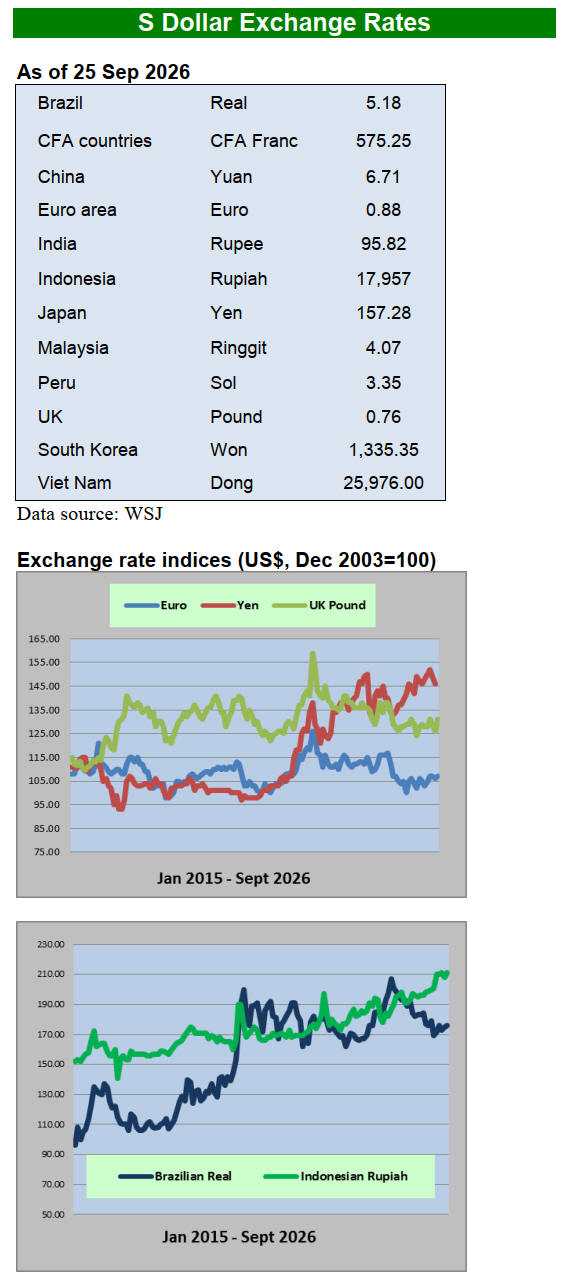
In September, the Indian rupee dropped to its lowest value
against the US dollar since late July falling to as low as 96
rupee to the US dollar. The downward pressure came
largely from global markets. Higher oil prices, rising US
Treasury yields and expectations of a stronger dollar are
all working against the currency.
See: https://www.globaltimes.cn/page/202609/1370701.shtml
Real estate sector 7- 8% of GDP
Real estate's contribution to India's GDP is substantial and
multi-dimensional, with direct construction and property
activity contributing approximately 7-8% of GDP while
broader economic linkages through construction materials,
professional services, financial services and consumer
spending amplify the total impact to an estimated 13-15%
of economic activity.
This makes real estate India's second-largest employment
sector after agriculture and one of the economy's most
significant structural contributors.
Commenting on the latest Reserve Bank of India decision
on interest rates, Shekhar Patel, the CREDAI
president, said “The RBI's decision to maintain the repo.
rate at 5.25% provides much-needed stability and
reassurance for the real estate sector.
Given the prevailing global uncertainties, maintaining the
status quo sends a positive signal of confidence and policy
continuity. Real estate is a long-gestation sector and
homebuyers make long-term financial commitments. A
stable interest-rate environment enables both developers
and buyers to plan with greater certainty.”
See: https://credai.org/media/view-details/?file_no=109
and
https://www.aurumproptech.in/pulse/faqs/what-percentage-of-
india-gdp-does-real-estate-contribute
Rapid depletion of rubberwood resources
According to Plyreporter the States of Kerala and
Karnataka (KK region) are home to more than 1,200
plywood and related industries most of which are small
scale enterprises utilising rubberwood, silver oak, neem
and some high forest species like vatta, valange, mango
and. The Kerala region is heavily dependent on
rubberwood with some quantities of silver oak and neem
core veneer being brought in from neighbouring Karnataka
State and around a 20% to 25% mix of random natural
forest species.
Most mills rely on rubberwood for peeling but the
expansion of particleboard capacitys over the last 5 years
is exerting tremendous pressure on rubberwood
availability.
In Kerala the average price of peeller logs has increased
from around INR6,500 per ton post-Covid19, to the
current monsoon levels (at the time of writing this article)
of INR12,000 per ton of green wood delivered at the
factory gate.
The overall shortage of rubberwood and mixed species is
expected to remain in the K&K region. Plyreporter
suggests resources in these States cannot supply the
requirements of particleboard mill and the expanding
plywood manufacturing capacity.
See: https://www.plyreporter.com/article/154383/timber-prices-
rise-in-southern-india-takes-its-toll-on-panel-sector
7.
VIETNAM
Wood and Wood Product (W&WP) Trade
Highlights
According to statistics from Vietnam Customs
Department, W&WP exports in August 2026 reached
US$1.58 billion, down 2% compared to July 2026 but up
7% compared to August 2025. WP exports contributed
US$1.03 billion, down 1% compared to July 2026 but up
6% compared to August 2025.
In the first 8 months of 2026, W&WP exports amounted to
US$11.8 billion, up 6% over the same period in 2025 of
which the WP exports share was US$7.6 billion, up only
0.2% over the same period in 2025.
Vietnam's office furniture exports in August 2026 were
valued at US$23.36 million, down 6% compared to
August 2025. In the first 8 months of 2026, office
furniture exports were estimated at US$183.7 million,
down 25% over the same period in 2025.
W&WP Exports to Japan in August 2026 earned
US$212.39 million, up 2% compared to August 2025. In
the first 8 months of 2026, W&WP exports to Japan
totalled US1.48 billion, up 5% over the same period in
2025.
W&WP imports in August 2026 totalled US$304.86
million, down 10% compared to July 2026 but up 6%
compared to August 2025. In the first 8 months of 2026
the import value of wood and wood products to Vietnam
totalled US$2.46 billion, up 17% over the same period in
2025.
Vietnam's oak imports in August 2026 were 65,000 cu.m,
worth US$39.0 million, up 3% in volume and 5% in value
compared to July 2026. Imports rose 25% in volume and
43% in value compared to August 2025. In the first 8
months of 2026 oak imports were estimated at 462,400
cu.m, worth US$277.4 million, up 30% in volume and
40% in value over the same period in 2025.
W&WP exports to the UK in August 2026 fetched
US$19.66 million, down 4% compared to August 2025.
In the first 8 months of 2026, W&WP products to the UK
market earned about US$176.3 million, up 11 % over the
same period in 2025.
Wood chip exports in August 2026 earned US$280
million, down 1% compared to July 2026 but up 33%
compared to August 2025. In the first 8 months of 2026
wood chip exports generated US$2.02 billion, up 25 %
over the same period in 2025.
Imports of raw wood (log and lumber) from Africa in
August 2026 stood at 80,000 cu.m, worth US$32.8
million, down 6% in volume and 11% in value compared
to July 2026 and down 3% in volume but up 10% in value
compared to August 2025.
In the first 8 months of 2026, imports of raw wood from
Africa were estimated at 601,400 cu.m, worth US$246.3
million US$, up 7% in volume and 23% in value over the
same period in 2025.
Forestry planning to protect livelihoods
After five years of implementation the existing plan had
produced positive results but new requirements, including
the country's goal of sustaining double-digit economic
made updates necessary.
Forestry plans must improve the livelihoods of people
living in forested areas while balancing economic
development, social welfare and environmental protection,
according to Deputy Prime Minister, Ho Quoc Dung.
The Deputy PM praised the Ministry of Agriculture and
Environment for its consultation process and preparation
saying the revised document broadly complied with
planning and forestry laws and was ready for
consideration and approval.
The plan takes into account climate change, environmental
pressures, timber and carbon markets, population growth,
migration and technological development, as well as the
links between forestry, biodiversity conservation, disaster
prevention, national defense and security and national park
management.
"Whatever the plan is, the lives of people in forested areas
must improve," Dung said, adding that plans must address
the livelihoods of those communities.
People living in forested areas play a direct role in
protecting forests, land, water resources and nature, he
said. The revised plan should therefore balance economic
development, social welfare and environmental protection.
According to a report by the ministry's Department of
Forestry and Forest Protection, which prepared the revised
plan, the adjustment aims to maximise the potential and
value of forests and develop forestry into a modern,
efficient and sustainable sector.
The revised plan is also intended to support socio-
economic development, environmental protection,
conservation of natural resources and improvements in
people's livelihoods. It aims to keep Việt Nam's forest
cover above 42% by 2030, while improving forest quality
and generating average annual GDP growth of up to 5.5%
for the forestry sector.
Trần Quang Bảo, Director of the Forestry and Forest
Protection Department, said the revised plan sets total
forest land at about 15.6 million hectares in 2030, around
300,000ha less than under the previously approved plan.
Annual timber harvesting from plantations is projected at
up to 31 million cubic metres with another roughly 10
million cubic metres coming from scattered trees, rubber
plantations and forest gardens.
See: https://vietnamnews.vn/economy/1799834/deputy-pm-calls-
for-forestry-planning-to-protect-livelihoods.html
Wood exports near US$12 billion in eight months
According to a September report from the Ministry of
Agriculture and Environment (MAE), exports were
estimated at US$1.48 billion in August alone, bringing the
eight-month total to US$11.69 billion. Wood and wood
products recorded the highest export value among
Vietnam’s agricultural commodities during the period.
The United States remained Vietnam’s largest export
market, accounting for 49.9% of total wood and wood
product exports. In effect, nearly US$1 of every US$2
earned from the sector came from the US market.
China, meanwhile, has rapidly expanded its purchases.
Vietnam’s wood and wood product exports to China
reached US$1.54 billion, up 46% year on year, lifting
China’s share to 15%, 4% percentage points higher than a
year earlier. China has overtaken Japan to become
Vietnam’s second-largest market for wood and wood
products.
Vietnam’s wood industry has established a strong position
in the US, becoming an important supplier as American
importers diversify their furniture supply chains. However,
the impact of higher trade costs is already becoming
visible.
US importers are becoming more cautious about signing
long-term contracts, shortening order cycles and seeking
greater cost-sharing from suppliers, potentially putting
further pressure on exporters’ margins.
The bigger risk is that Vietnamese suppliers could
gradually lose their position in US supply chains. Once
importers shift to alternative sources and establish new
inspection, logistics and product-standard systems,
regaining market share could become considerably more
difficult.
For Vietnamese wood exporters, maintaining customer
confidence in the US market is therefore becoming more
important than retaining orders at any cost, according to an
industry expert.
The MAE is working with wood industry associations to
help businesses respond to US anti-dumping and
countervailing duty investigations, including the hardwood
plywood case, as well as participate in the Section 301
investigation hearings. The ministry is also proposing
measures to address VAT-related difficulties in wood
exports to provide timely support for businesses.
See: https://vir.com.vn/vietnam-wood-exports-near-117-billion-
in-eight-months-160352.html?utm_source=chatgpt.com
Vietnam and Poland strengthen strategic partnership
in furniture supply chains
Representatives of leading Polish manufacturers of
agricultural and forestry machinery have expressed strong
interest in Việt Nam’s potential in both furniture
manufacturing and mechanical engineering and
manufacturing.
As two of the world's top three furniture exporters,
Vietnam and Poland have significant potential and
opportunities to work together in furniture manufacturing
supply chains. Vietnam and Poland have furniture exports
of approximately US$3.7 billion and US$3 billion,
respectively, according to data from the trade data
analytics organization OEC.
However, in addition to its furniture manufacturing and
export industries, Poland also boasts a significants
industry producing machinery and equipment for forestry
and wood processing. This creates considerable potential
for the two countries to cooperate in developing supply
chains for furniture manufacturing.
Although both countries are among the world’s leading
furniture producers, their furniture industries are not
directly competitive due to differences in product
categories and end-user markets. More importantly, their
respective manufacturing capabilities offer complementary
strengths that could help unlock greater cooperation
potential.
Polish agricultural and forestry equipment is already used
in markets around the world but remains relatively
unfamiliar in Southeast Asia. Polish manufacturers hope
Vietnam can serve as a gateway for Polish products to
access the wider regional market. The effective operation
of Polish machinery in Viet Nam, they said, would also
serve as a powerful showcase for the quality of Polish
equipment across Southeast Asia.
At the same time, with one of Europe’s largest areas of
planted forests, Poland could potentially serve as a source
of raw materials and input components for Viet Nam’s
furniture industry, the Vietnam Trade Office in Poland
said at a sideline forum during the international trade fair
on wood and furniture industries in Poland this month.
See: https://vietnamnews.vn/economy/1800057/viet-nam-and-
poland-strengthen-strategic-partnership-in-furniture-supply-
chains.html?utm_source=chatgpt.com
Repositioning Viet Nam’s domestic wood product
market as a growth driver for local industries
In a recent article Ngo Sy Hoai, Secretary General, Viet
Nam Timber and Forest Products Association
(VIFOREST) says “Viet Nam needs a genuine domestic-
market programme and he sets out how this could become
a driver of investment in the wood products sector.”
Highlights of the article are provided below and the full
article can be obtained from the author at:
ngosyhoai89@yahoo.com
With a population of more than 100 million, annual
population growth of around 1%, rising incomes and
living standards, rapid urbanisation, and expanding
demand for housing, furniture, wood-based materials,
paper and packaging and biomass energy, Viet Nam’s
domestic market has the potential to become a major
growth driver for the wood industry over the coming
decade.
The challenge is not simply how to sell more wooden
furniture to Vietnamese consumers. More fundamentally,
the industry needs to move from the idea of merely
“exploiting the domestic market” towards building a
domestic ecosystem for sustainable wood use.
This would be one in which timber is legal, fit for purpose,
economically valuable, safe for consumers, long-lived and,
where possible, reused before eventually becoming an
energy source.
Viet Nam now has a population of more than 100 million.
Using a conservative estimate of current spending on
wood and wood products of about US$50 per person per
year, the domestic market is already worth around US$ 5
billion.
This demand base is continuing to expand. Population is
growing by around 1% per year; the number of urban
households is increasing and demand for new housing,
refurbishment, renovation and furnishing continues to rise.
At the same time the expanding middle class is changing
how it assess products, shifting from a focus on the
amount and weight of wood and low prices towards
design, functionality, safety, warranties, origin and
environmental responsibility.
Under a scenario in which Viet Nam sustains high GDP
growth, the domestic wood market could plausibly expand
by around 7–9% per year. This would be faster than the
roughly 6% annual growth in global wood demand used as
a reference assumption in the analysis.
At such growth rates, the domestic market could reach
about US$7.0–7.7 billion by 2030. Under the central
scenario of 8% annual growth, the market would be
approximately US$ 7.35 billion.
More importantly, a large and well-organised market
can
encourage companies to make long-term investments in
design, branding, mass production, after-sales service and
traceability, all areas that remain comparatively
underdeveloped in the domestic market.
The domestic market is far more than wooden tables,
chairs, beds and cabinets
A long-standing limitation in thinking is to equate the
“domestic wood market” with household furniture. In
reality, domestic demand is emerging from at least five
major market groups.
Construction / mass timber: Doors, flooring,
structural elements, prefabricated housing,
engineered wood
Interior and exterior furniture: Households,
offices, hotels, public buildings
Paper and packaging: E-commerce, logistics,
consumer packaging, plastic substitution
Biomass energy: Co-firing, industrial boilers,
gradual fossil-fuel substitution
Bio-based materials: Cellulose, composites, new
materials, circular-economy applications
Strong demand, but weak ‘market infrastructure’
The biggest weakness of the domestic market is not a lack
of demand. Rather, the market still lacks the institutional
and commercial “infrastructure” needed to turn demand
into sustainable growth.
First, supply remains highly fragmented. Craft villages,
household producers and small workshops play a major
role in supplying furniture, doors, traditional products and
made-to-order items. They benefit from craftsmanship,
flexibility and competitive costs, but often face constraints
in kiln drying, chemical control, traceability, testing and
warranties.
Second, product transparency remains limited. Consumers
often cannot easily determine the species used, the origin
of the timber, the type of adhesive or coating,
formaldehyde emissions, moisture content, expected
service life or who is responsible when a product fails.
Third, branding and after-sales services are
underdeveloped. In a modern market, companies do not
merely sell a table or a cabinet; they also sell design,
delivery, installation, warranty, repair and component
replacement.
Fourth, technical standards for many product groups have
not yet become routine market practice. Requirements on
chemical safety, durability, moisture resistance, emissions,
fire performance and recyclability need to be further
developed and mainstreamed.
Finally, data remain weak. Viet Nam has relatively good
foreign-trade statistics, but it is still difficult to measure
domestic wood consumption, wood used in buildings,
household furniture demand, recovered wood, reuse flows
and regional supply-demand balances.
Green public procurement: government should
become a lead customer
One of the most effective instruments for developing a
formal domestic wood market is green public
procurement. Government is a major purchaser for
schools, hospitals, offices, cultural facilities, social
housing and other public buildings.
If procurement is based only on the lowest price, better
and more responsible products have little opportunity to
gain a market advantage.
By contrast, if tender documents require legal timber
origin, product durability, formaldehyde limits, safe
adhesives and coatings, warranty periods, repairability,
ease of disassembly and options for take-back and reuse,
public procurement can create a large, stable and
transparent market.
When the public sector buys according to clear standards,
companies have incentives to invest in mass production,
testing, traceability and after-sales services. Scale can
reduce unit costs and standards first established in public
procurement can eventually become normal expectations
in the private market. A national programme could be
developed around the message “Vietnamese Wood for
Vietnamese Buildings”, initially focusing on social
housing, schools, hospitals, cultural facilities, public
offices and selected tourism and public projects.
Businesses must change as well
Policy is only half of the story. Wood-industry companies
themselves need to change the way they approach the
domestic market. The old model is typically characterised
by one-off product sales, price-based competition, limited
consumer data and weak warranty and repair services.
The new model should be a product-and-service
ecosystem: design for specific market segments; modular
production; multi-channel sales; e-commerce; professional
delivery and installation; long-term warranties; repair and
component replacement; disclosure of raw-material origin;
and transparent information on product quality, chemicals
and life cycle.
The domestic market should not be treated as a place to
dispose of “left-over orders”. It should become a platform
for building Vietnamese brands, Vietnamese design and
Vietnamese services.
Viet Nam needs a genuine domestic-market
programme
For 2026–2027, the first priority should be data: measure
domestic consumption, estimate market size, build a wood
material-balance system and assess the capacity of craft
villages, mills and major user groups. Sustainable-biomass
standards for industrial boilers and co-firing should also be
piloted.
During 2028–2029, Viet Nam should expand green public
procurement, sustainable-wood product labelling, green
craft-village clusters and standards for panels, furniture,
construction timber and biomass.
By 2030, the country should reassess the scale and
structure of the domestic market, expand the “Vietnamese
Wood for Vietnamese Buildings” programme, strengthen
circularity in wood and paper, and increase the role of
biomass alongside wind and solar in the renewable-energy
system.
Final message
• A wood market of more than 100 million people
cannot be built on products of uncertain origin
and unverified quality.
• If domestic demand is organised well, Viet Nam
will not simply sell more wood products; it will
use every cubic metre more intelligently, more
cleanly and with greater value.
This is the real meaning of repositioning the domestic
market as a major future growth driver for Viet Nam’s
wood industry.
8. BRAZIL
Advancing adoption of latest timber
traceability
technologies
The Center for Timber Producing and Exporting Industries
of the State of Mato Grosso (CIPEM) presented to the
Brazilian Institute of Environment and Renewable Natural
Resources (IBAMA) a project to improve the
identification, traceability and control of legally produced
timber in the state of Mato Grosso, with a focus on Ipê,
Cumaru and Cedro-Rosa species which are listed in
Appendix II of CITES.
The initiative proposes the establishment of two advanced
facilities equipped with xylotheques for detailed
anatomical analyses and the training of professionals in
technical species identification.
The project will be coordinated by the Federal Rural
University of the Amazon (UFRA) with the participation
of the State University of Mato Grosso (UNEMAT). It
seeks to meet the requirements of IBAMA Normative
Instruction No. 28/2024, reduce the risk of identification
errors and enhance legal certainty throughout the timber
value chain, particularly in northern Mato Grosso.
With international markets becoming increasingly
demanding proof of legal timber origin, more efficient
identification and traceability systems can help facilitate
exports, reduce trade-related queries and increase buyer
confidence.
In recent years, demand for timber with verified origin has
grown in international markets, particularly in Europe,
North America and Asia. Through more modern
traceability tools, Mato Grosso seeks to strengthen its
position in sustainable forest management. The proposal is
being reviewed by IBAMA to determine the next steps and
a possible institutional partnership.
See: https://maisfloresta.com.br/mato-grosso-aposta-em-
tecnologia-para-proteger-mercado-bilionario-da-madeira-legal/
New ABNT Standard for Products from the Amazon
Region
The Brazilian Association of Technical Standards (ABNT)
has published ABNT NBR 20260:2026, the ‘General
Standard for the Amazon Seal Programme’ establishing
environmental, social and economic requirements for
industrial products and services produced or provided in
the Legal Amazon using inputs from the biome.
The Standard provides the Amazon Seal Programme
(Programa Selo Amazônia), led by the Ministry of
Development, Industry and Foreign Trade (MDIC), with
technical parameters to recognise initiatives that combine
sustainable production, value generation and conservation
of the Amazon. The Seal is one of actions established
under the 2025–2026 Action Plan of the National Quality
Infrastructure Strategy (ENIQ).
The Standard considers the entire life cycle of products
and services. Under the environmental pillar, it establishes
requirements related to combating illegal deforestation,
biodiversity conservation, reducing greenhouse gas
emissions and waste management based on the circular
economy. The social pillar addresses decent work, the
valorisation of the regional workforce and respect for the
rights and knowledge of indigenous peoples and
traditional communities.
In terms of economic and governance aspects, it includes
strengthening local micro and small enterprises,
encouraging innovation, adopting anti-corruption practices
and maintaining traceability records for suppliers, batches
and the origin of inputs.
Implementation of the Selo Amazonia will include the
development of three sector-specific Standards for priority
value chains, followed by training for interested
companies and audits conducted by Product Certification
Bodies (OCPs) for issuance of certificates.
See: https://www.gov.br/mdic/pt-br/assuntos/noticias/2026-
periodo-eleitoral/setembro/nova-norma-da-abnt-fixa-regras-de-
sustentabilidade-para-produtos-da-regiao-amazonica
Export update
In August 2026, Brazilian exports of wood-based products
(except pulp and paper) increased 14% in value compared
to August 2025, from US$220.5 million to US$251.2
million.
Pine sawnwood exports increased 37% in value between
August 2025 (US$42.6 million) and August 2026
(US$58.4 million). In volume, exports increased 25% over
the same period, from 191,100 cu.m to 239,300 cu.m.
Tropical sawnwood exports increased 16% in volume,
from 22,100 cu.m in August 2025 to 25,600 cu.m in
August 2026. In value, exports increased 48% from
US$8.7 million to US$12.9 million over the same period.
Pine plywood exports increased 24% in value between
August 2025 (US$42.8) and August 2026 (US$53.2). In
volume, exports increased 21% over the same period, from
136,700 cu.m to 165,000 cu.m.
Tropical plywood exports increased 25% in volume, from
2,800 cu.m in August 2025 to 3,500 cu.m in August 2026.
In value, exports increased 40% from US$1.5 million in
August 2025 to US$2.1 million in August 2026.
As for wooden furniture, exports increased 3% in value,
from US$44.6 million in August 2025 to US$45.9 million
in August 2026.
‘Woodtrade Brazil’ discussed prospects for the timber
industry in the global market
The 6th Woodtrade Brazil brought together more than 500
business owners, executives and representatives of the
timber value chain in Curitiba, Paraná, southern Brazil to
discuss the prospects for the timber industry in the global
market.
The programme addressed the performance of the timber
segments, access conditions to international markets,
technological transformations and economic and political
scenarios, with emphasis on the impacts of international
tariffs, logistical constraints and changes in foreign trade
flows.
Efficiency gains, innovation, artificial intelligence and
professional training were also discussed as factors related
to the competitiveness of Brazil’s forest sector. A panel on
the wood product markets analyzed production, domestic
consumption and export data for pellets, sawnwood,
plywood, flooring, doors, mouldings, pallets and
packaging, as well as the effects of tariff conditions on
products destined for the US market and on Brazilian
competitiveness in other countries.
The event also highlighted the timber construction market
where engineered wood production in Brazil reaching
14,000 cu.m in 2025, compared with an estimated installed
capacity of 70,000 cu.m per year. The consolidation of
demand and updating municipal building codes remain
challenges for the expansion of this market.
The Brazil-US trade relationship was also discussed,
including the effects of the tariff environment on
companies and the prospects for negotiations between the
two countries. The importance of preserving the strategic
relationship between Brazil and the US regardless of the
governments in power was emphasised.
See: https://abimci.com.br/com-mais-de-500-participantes-
woodtrade-brazil-debate-as-perspectivas-da-industria-madeireira-
no-mercado-global/
US tariffs and the competitiveness of Brazil’s timber
industry
The tariffs imposed by the United States have increased
pressure on Brazil’s timber industry and reinforced the
need for market diversification, lower logistics costs and
increased productivity.
Between January and August 2026, compared with the
same period in 2025, exports of pine plywood declined by
14%, while exports of mouldings and wooden doors
decreased by 50% and 24% respectively. Pine sawnwood
exports, on the other hand, increased by 6% in volume.
During the hearings held in July by the Office of the
United States Trade Representative (USTR), the
Federation of Industries of Paraná (FIEP) defended
Brazilian products, highlighting the importance of
Brazilian supply to US production chains, commercial
relationships built over decades and the risks of increased
costs and supply restrictions in the US market.
One measure specifically targeting Brazil established a
25% tariff on certain products, while another, related to an
investigation into measures to combat forced labour in
supply chains, imposed an additional 12.5%. These
charges may be cumulative when both apply to the same
item resulting in a 37.5% additional tariff on certain wood
products and furniture.
In this context, the importance of market diversification,
continued negotiations and maintaining trade relations
with the United States was highlighted. In addition to
external restrictions, FIEP highlighted logistical
bottlenecks and the need for investments in infrastructure,
technology and forest productivity to strengthen the
sector’s competitiveness.
As an alternative to expanding domestic demand,
participants highlighted timber construction and greater
value addition to wood products, supported by public
policies, training and financing. Expanding the domestic
market was identified as a potential pathway in response to
the challenges facing foreign trade.
See: https://www.remade.com.br/noticias/21632/tarifas-dos-eua-
pressionam-setor-madeireiro-e-ampliam-debate-sobre-
competitividade-no-brasil
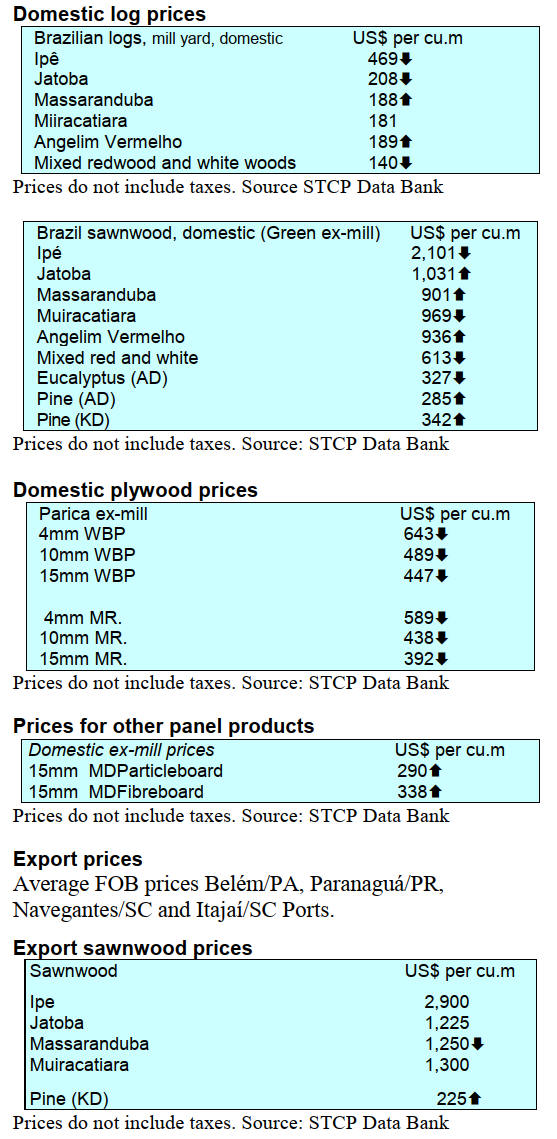
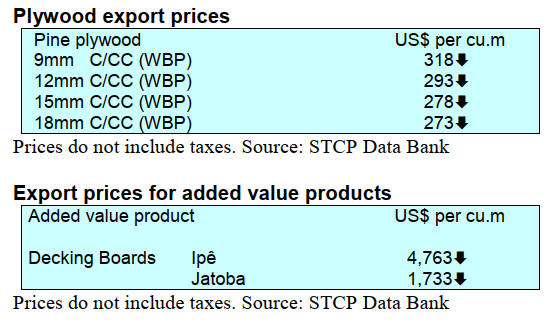
Through the eyes of industry
The latest GTI report lists the challenges identified by the
private sector in Brazil.
See:
https://www.itto.int/direct/topics/topics_pdf_download/topics_id
=596778&no=1
9. PERU
Exports higher in in July
In July 2026 wood product exports recorded an FOB value
of US$40.8 million, an increase over the US$37.4 million
reached during the same period in 2025. This rise
represented a positivee change of 9%, according to the
Center for Research on Global Economics and Business of
the Association of Exporters (CIEN-ADEX).
According to the data the export portfolio included
products such as semi-manufactured goods (US$15.6
million), sawn timber (US$13.5 million), firewood and
charcoal (US$3.7 million), furniture and parts (US$2.5
million) and construction products (US$2.2 million).
France was the leading destination with shipments
totalling US$7.1 million. France was followed by the
United States (US$5.6 million), the Dominican Republic
(US$5.3 million), China (US$5.2 million) and Viet Nam
(US$4.4 million).
Semi-manufactured products drove exports in July
According to data from the ADEX Services and Extractive
Industries Division, exports of semi-manufactured
products reached US$15.6 million (FOB) in July 2026,
representing a 34% increase compared to the same month
of the previous year. France led imports in this subsector,
accounting for 42% of the total exported and recording a
44% increase compared to July 2025.
Denmark took second place with a 16% share and notable
growth of 198%. The United States was third placed with
a 9% share, although it recorded a 21% decrease compared
to the same period the previous year.
Belgium held fourth place with a 8% share and a
contraction of 27% year on year. Mexico rounded out the
top five destinations, accounting for 5% of exports and
showing remarkable growth of 206% compared to July
2025.
These results demonstrate a favorable recovery in
foreign
trade for Peruvian wood products driven primarily by the
dynamism of the semi-manufactured products subsector
and strengthening demand in some European markets.
Serfor promotes occupational competency in forest
plantations
The National Forest and Wildlife Service (Serfor), in
coordination with the Ministry of Labour and Employment
Promotion (MTPE), spearheaded the development of the
Occupational Competency Standard (ECL) for Forest
Plantations. This initiative is part of broader efforts to
strengthen the recognition and certification of skills for
workers in the forestry sector.
Within this framework, professionals from Serfor’s
Directorate of Promotion and Competitiveness, along with
other forestry experts, participated in the validation
process for the Forest Plantations ECL, as well as its
assessment tools and equipment list, in the Cajamarca
region.
The validation sessions, also attended by personnel from
Serfor’s Technical Forestry and Wildlife Administration
(ATFFS) in Cajamarca, were supported by the Technical
Unit of CITE Madera Cajamarca which contributes to the
technical activities planned for this process.
The participation of these specialists made it possible to
gather technical input and insights to strengthen the
criteria, procedures and conditions required for assessing
the occupational competencies associated with the
establishment and management of forest plantations.
See: https://www.gob.pe/institucion/serfor/noticias/1449122-
serfor-impulsa-la-certificacion-de-competencias-laborales-en-
plantaciones-forestales
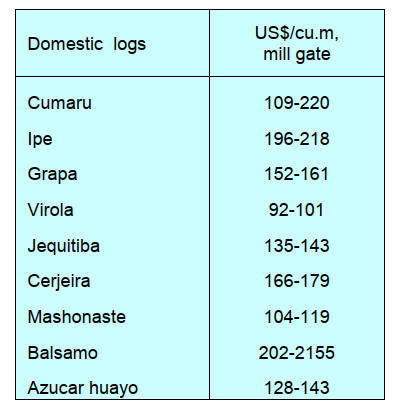 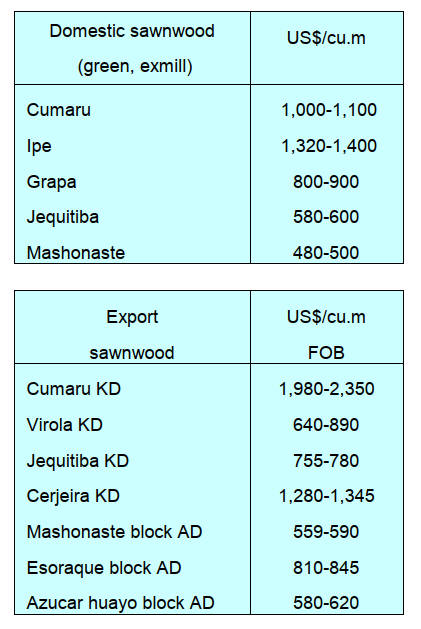 |