Japan
Wood Products Prices
Dollar Exchange Rates of 10th
March
2026
Japan Yen 158.05
Reports From Japan
Record-breaking 2026 buget
The adoption of a record-breaking 122.3 trillion yen
(US$785 billion) budget for fiscal 2026 in Japan is widely
considered risky, though it is viewed by the government as
a necessary measure for economic security and
stability. The budget aims to boost defense spending and
stimulate the economy but it has triggered concerns
regarding fiscal sustainability. Japan has the highest debt
burden among developed economies, at over twice the size
of its economy.
Critics fear that the budget that includes a massive
stimulus package, could fuel inflation which is already
hovering around 3% and undermining household finances.
Despite the risks, many analysts believe a crisis is not
imminent because a large portion of the debt is held by the
Bank of Japan and local institutions, reducing the risk of
capital flight.
See: https://www.nippon.com/en/news/yjj2026031300179/
Conflict in Middle East could affect annual wage
negotiations
The Middle East conflict is likely to affect Japan's spring
wage negotiations ("shunto") by increasing uncertainty,
complicating the Bank of Japan's (BoJ) policy direction.
While major firms are expected to grant significant pay
raises, high energy prices from the conflict could pressure
real wages and dampen economic growth, likely forcing
the BoJ to delay interest rate increaese.
The Middle East conflict has raised the chances of the BoJ
skipping a rate increase in March as they assess risks to
economic stability, potentially waiting until April, May, or
even June to act. The sharp rise in oil prices will increase
Japan's import costs, pushing up the inflation rate. This
scenario could impact the annual wage negotiations.
January wages growth outpaced inflation
In January real wages in Japan climbed for the first time in
13 months as inflation cooled, with base salaries growing
at their fastest pace in 33 years, government data showed.
The positive turn strengthens the case for the BoJ to keep
raising interest rates to normalise monetary policy.
Average nominal wages, or total cash earnings, increased
3% year-on-year to 301,314 yen ($1,911) marking the
fastest pace since July last year.
The growth in pay was enough to outpace the consumer
inflation rate the ministry uses to calculate real wages.
That was 1.7% in January, the slowest gain since March
2022, thanks to fuel subsidies and fewer food price hikes.
See: https://www.asahi.com/ajw/articles/16407483
Release of some oil reserves
The government will release a total of 45 days' worth of
oil, comprising 15 days of private-sector reserves and one
month of government-held reserves. With most of its oil
sourced from the Middle East, Japan is acting due to
concerns that conflict, specifically around the Strait of
Hormuz, will significantly disrupt oil imports.
The government aims to keep the average retail price of
gasoline around 170 yen (US$1.07) per litre, using
subsidies for oil wholesalers but this is still a major
increase that will eventually translate to higher costs in
many sectors.
Japan depends on the region for more than 90% of its oi,
and Iran’s effective blockage of the Strait of Hormuz,
preventing tankers from passing through, has led to
mounting supply concerns. Prime Minister Takaichi Sanae
responded on March 11, 2026, by announcing plans to
release 45 days’ worth of oil, amounting to almost 20% of
the nation’s reserves, from March 16 onward.
To prevent a shortfall in supply from causing upheaval in
Japan, whether due to political unrest or major disaster
overseas, private-sector actors have held oil reserves from
fiscal 1972 onward and the national government has
maintained reserves since fiscal 1978.
As of December 31, 2025, Japan’s state reserves held oil
equivalent to 146 days’ consumption, while private-sector
reserves held 101 days’ worth, and joint reserves with oil-
producing countries had 7 days’ worth. This adds up to
254 days’ worth of oil overall, or 470 million barrels.
See: https://www.nippon.com/en/japan-data/h02732/
Middle East conflict clouds decisions on interest rates
The consensus amongst analysts is that the BoJ will keep
its key interest rate at 0.75% but likely raise it to 1.00% by
end-June. The Middle East conflict has reignited global
inflation fears due to escalating oil prices and this
complicates central bank policy decisions as they grapple
with supply shocks and weaker economic growth.
See: https://www.reuters.com/world/asia-pacific/boj-raise-
interest-rates-next-quarter-with-expectations-unchanged-by-
middle-east-2026-03-11/
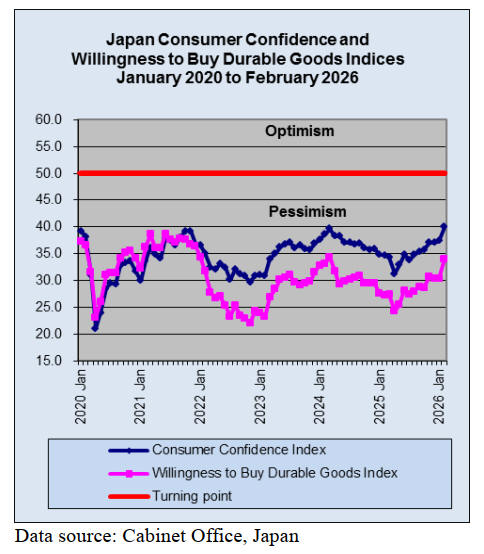
Consumers adopt cautious approach to purchasing
In the third quarter of 2026 Japanese consumers were
beginning to reduced spending on durable goods as
inflation persists. While wages are rising they have often
struggled to keep pace with the rising costs of daily
necessities, prompting consumers to adopt a more cautious
and selective approach to purchasing non-essential, long-
lasting items. Spending on durable items such as furniture
dropped almost 11% in January
Many households are adopting a defensive stance,
prioritising savings and holding off on large purchases
despite some signs of recovery in real wages.
The spending data is a key indicator of private
consumption, which accounts for more than half of Japan's
gross domestic product.
See:
https://mainichi.jp/english/articles/20260310/p2g/00m/0bu/0100
00c
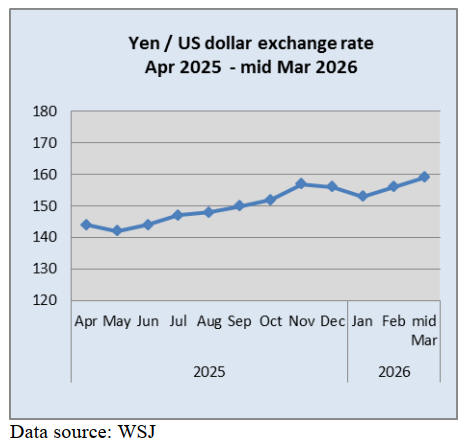
Yen weakens, safe haven status in doubt
The yen is weakening as the conflict in the Middle East
worsens with the currency's safe-haven image tarnished by
concerns that higher crude oil prices will widen Japan's
trade deficit and the recently adopted national budget is
unsustainable.
The Japanese yen traded at levels not seen in about 20
months in a dramatic drop on 13 March and looked likely
to drop further which could trigger intervention by
Japanese authorities. Some are suggesting the yen could
fall below the 161 level seen around 40 years ago.
See:
https://www.japantimes.co.jp/business/2026/03/13/markets/yen-
weakens-us-dollar/
Exchange rate movements an increasingly important
driver of inflation outlook
Bank of Japan Governor Kazuo Ueda has warned that
exchange rate movements are becoming an increasingly
important driver of Japan’s inflation outlook, highlighting
the growing influence of the weaker yen as rising energy
prices threaten to reignite cost-push inflation.
“Foreign exchange is one important factor affecting the
economy and prices,” Ueda said, adding that policymakers
must remain mindful that currency swings can influence
inflation expectations. The yen depreciation amplifies the
inflationary impact of higher commodity prices by
increasing the cost of imports.
See: https://investinglive.com/centralbank/bojs-ueda-warns-
weak-yen-could-amplify-inflation-as-oil-prices-rise-20260312/
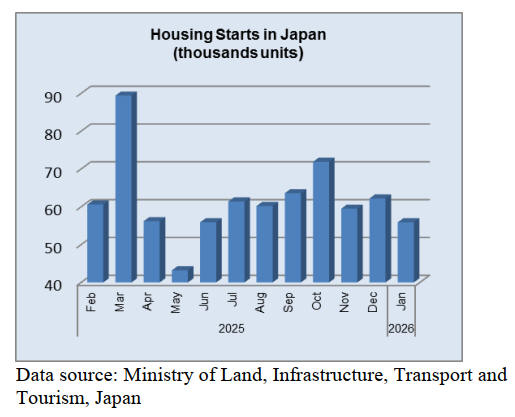
Strong housing growth in Urban areas
Japan's housing demand is experiencing strong, localised
growth in urban centers, particularly Tokyo, driven by
foreign investment and redevelopment, while rural areas
face decline. Major cities (Tokyo, Osaka, Fukuoka) show
rising prices and increasing rents for new properties,
though national demand is weakening overall due to
demographic contraction.
Increasing construction costs and mandatory energy-
saving standards are driving up prices for new homes.
Potential interest rate adjustments could significantly
affect mortgage affordability and total residential demand.
See:https://www.landhousing.co.jp/for-foreigner/column/50
and
https://www.cbre.co.jp/en/insights/reports/japan-market-outlook-
2026
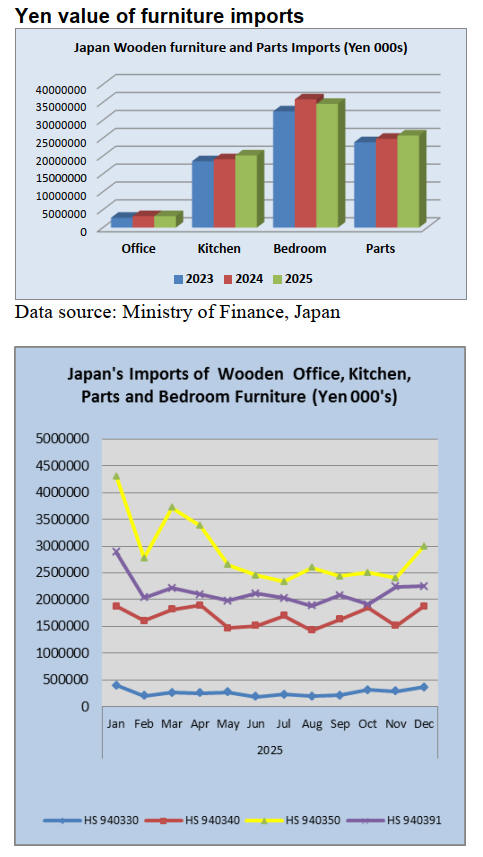
December 2025 wooden office furniture imports
(HS940330)
December saw a rise in the proportion of wooden office
furniture imports from China which jumped to 94% of all
HS940330 imports (85% in November). The other main
suppliers in December were Spain and Thailand. There
were no imports of wooden office furniture from Thailand
in November.
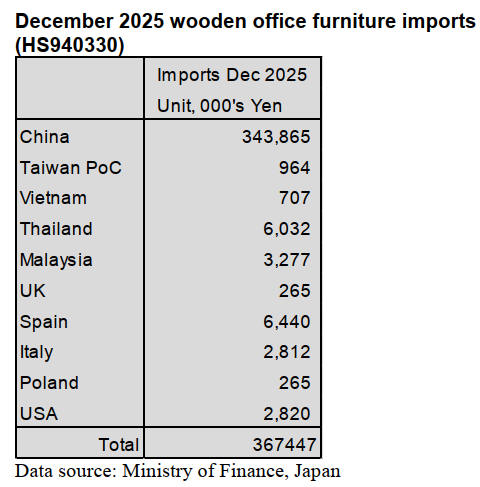
The top three shippers accounted for 97% of Japan’s
December 2025 imports of wooden office furniture.
The total value of HS940330 imports in December was
12% higher than in November. Year on year December
2025 imports were almost 30% higher.
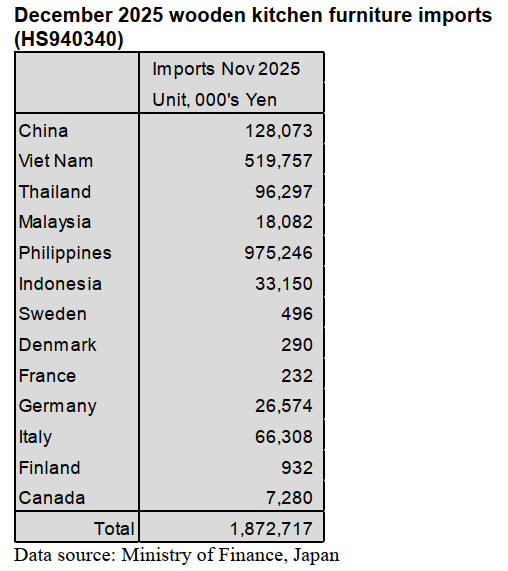
December 2025 wooden kitchen furniture imports
(HS940340)
In December 2025, the top three shippers of wooden
kitchen furniture (HS940340) accounted to just over 92%
of all HS940340 imports. The value of shipments from the
Philippines accounted for most (52%, 49% in November).
Shippers in Viet Nam contributed a further 28% to
December imports followed by China (7%) and Thailand.
December import values for HS940340 from the
Philippines rose sharply (31%) from a month earlier.
December arrivals from Viet Nam were up 16% month on
month while the value of December shipments from China
wer little changed from a month earlier.
Year on year the value of December wooden kitchen
furniture imports was up 7%.
November 2025 wooden bedroom furniture imports
(HS940350)
In a correction to the long period from mid-2025 when the
value of wooden bedroom furniture hardly changed there
was an over 30% jump in the value of December imports
but despite this increase the value of second half 2025
imports was far below that in the first half of the year.
As was the case throughout 2025 imports of wooden
bedroom furniture were dominated by shippers in China
and Viet Nam. Over 90% of the value of HS940350 in
December was shipments from China (60%) and Viet
Nam (30%). The third and forth largest value of shipments
were from Malaysia and Italy.
Year on year there was a 4% decline in the value of
December imports.
 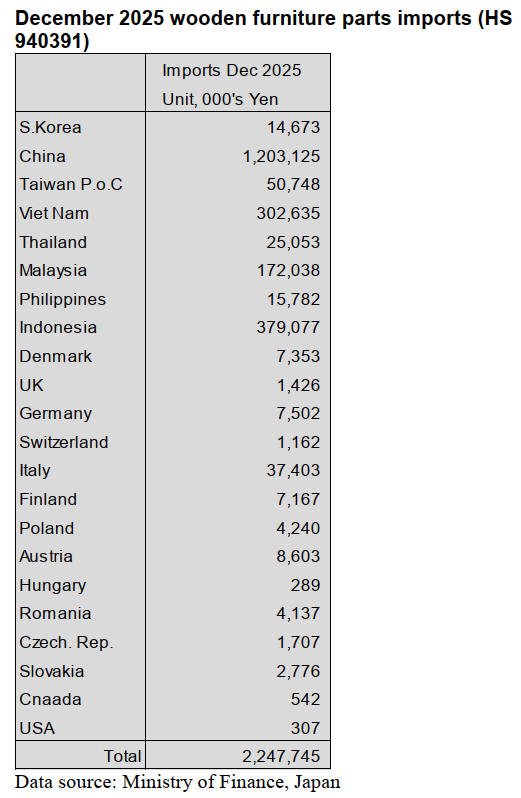
December 2025 wooden furniture parts imports
(HS940391)
Shippers in China and three SE Asian countries,
Indonesia, Viet Nam and Malaysia accounted for over
90% of Japan’s December imports of wooden furniture
parts (HS940391). These countries were the main source
of parts throughout 2025.
Shipments from China accounted for 53% of the total
value of December imports. The second largest shipper
was Indonesia at 17%, down from 20% in November
followed by Viet Nam at 14% and Malaysia 4%.
December arrivals from China and Viet Nam were at
around the same levels as in November. Arrivals from
Indonesia were down 14% with only Malaysia, among the
top shippers, seeing an increase of 24%. Year on year, the
value of December imports of HS940391 rose 6%.
Trade news from the Japan Lumber Reports (JLR)
The Japan Lumber Reports (JLR), a subscription trade
journal published every two weeks in English, is
generously allowing the ITTO Tropical Timber Market
Report to reproduce news on the Japanese market
precisely as it appears in the JLR. For the JLR report
please see: https://jfpj.jp/japan_lumber_reports/
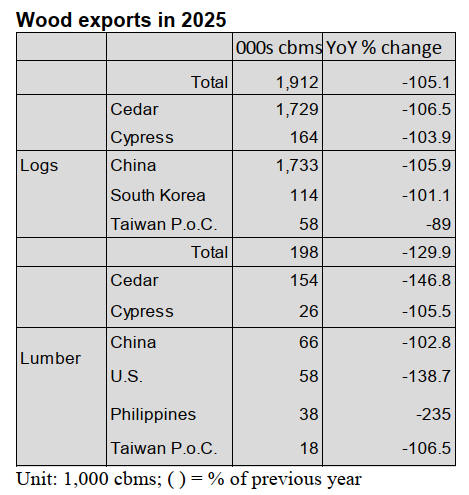
Wood export in 2025
In 2025, Japan’s wood exports totaled 1,912,494 cbms of
logs, a 5.1% increase from the previous year, and 198,690
cbms of lumber, a 29.9% increase. Log exports reached a
record high for the third consecutive year. Lumber exports
increased for the second consecutive year, reaching the
second-highest level on record after 2021.
Against the backdrop of sluggish domestic demand
and
improved cost competitiveness due to the weak yen,
domestic businesses became more eager to export. The
value of wood exports reached 59.5215 billion yen, up
10.9% from the previous year, marking a record high for
the second consecutive year.
China-bound log exports totaled 1,733,267 cbms, up
5.9%
from the previous year. Exports to South Korea reached
114,308 cbms, a 1.1% increase, while exports to Taiwan
PoC were 58,571 cbms, an 11.0% decrease. As a result,
shipments to China have grown for three consecutive
years and those to South Korea for two consecutive years,
whereas exports to Taiwan PoC PoC have declined for
three years in a row.
Exports to Viet Nam totaled 4,531 cbms, a 13.3% increase
from the previous year, marking the first rise in five years.
In addition, exports to Cambodia reached 1,065 cbms, up
from 54 cbms the previous year, and exports to Thailand
were 625 cbms, compared with zero the year before. These
figures indicate emerging efforts to develop new markets.
Regarding exports to China, the key issue was the outlook
for U.S. tariffs on Chinese goods under the Trump
administration. However, driven by a rush in demand
ahead of the tariff implementation, shipments in the first
half of the year exceeded 940,000 cbms, a substantial
25.1% increase from the same period of the previous year,
marking a notably high level. However, once the U.S.–
China tariff war began, purchasing dropped sharply. Due
in part to declining sales prices, volumes in August fell
sharply to 85,227 cbms, a 34.2% decrease from the same
month of the previous year.
From September onward, export volumes recovered,
reaching 169,644 cbms in October, a 25.8% increase from
the same month of the previous year.
Sawn timber exports were as follows: shipments to China
reached 66,019 cbms, up 2.8% from the previous year;
exports to the United States totaled 58,246 cbms, a 38.7%
increase; those to the Philippines amounted to 38,436
cbms, a sharp rise of 135.0%; exports to Taiwan PoC were
18,668 cbms, up 6.5%; and shipments to South Korea
came to 9,590 cbms, a 15.5% increase.
The increases were seen for China, the United States, and
South Korea for the second consecutive year, for Taiwan
PoC for the sixth straight year, and for the Philippines for
the first time in four years.
Exports of sawn timber to Viet Nam reached 5,166 cbms,
up from 876 cbms in the previous year, marking a record
high.
Plywood supply in 2025
The supply of plywood in 2025 reached 4,637,000 cbms, a
slight increase of 0.4% from the previous year, marking
the second consecutive year of growth. Domestic plywood
production increased slightly, rising 2.5% from the
previous year, while imports of plywood declined 1.9%
year-on-year, showing weak growth.
Production of domestic softwood structural plywood
increased 2.8% year-on-year in 2025, marking the second
consecutive year of growth. Shipments increased 3.3%
year-on-year, slightly exceeding production.
The months in 2025 when shipments exceeded 200,000
cbms were January, April, and October. Japan’s housing
starts totaled 740,000 units in 2025, down 6.5% from the
previous year, underscoring the continued lack of
underlying demand.
Among the major supplying regions, shipments from
Malaysia and China have declined. Plywood from
Malaysia fell below 40,000 cbms in both November and
December, marking a low level, and total arrivals for 2025
ended 2.3% lower than the previous year.
Plywood from Indonesia was essentially flat, edging up
just 0.1% from the previous year. In contrast, imports from
Viet Nam rose 6.2% from the previous year, marking a
second consecutive annual increase.
Plywood price hikes
Nisshin Group and Shimane Plywood will raise the price
of 12 mm, 3×6 structural softwood plywood starting with
March shipments.
As plywood prices continue to soften in the Tokyo
metropolitan area and other regions, the companies are
raising prices to address rising costs such as higher log
prices and wage increases, as well as to secure a stable
supply of logs and finished products. They will first move
to raise the delivered price to wholesalers to 1,100 yen per
sheet.
Plywood price increases
Key-Tec Co., Ltd. raised the price of domestically
produced structural softwood plywood for orders received
from February 21. The company cited persistently high
costs for electricity, adhesives and other inputs,
concluding that a price revision was unavoidable to ensure
the sustainability of its operations.
Compared with pre–wood shock levels, log prices for
plywood production are roughly 30 % higher, and the
current log supply–demand balance is tightening as
harvesting volumes decline
Price hike of plywood
Seihoku Corporation will raise the price of its softwood
structural plywood in March to at least 1,110 yen per
sheet, seeking to offset falling market prices and rising
labor, transport, and log costs
South Sea logs and products
Prices for tropical hardwood and China-made products are
showing signs of rising, particularly for Indonesian items.
Supplies of natural hardwood logs are tightening as
prolonged production cuts at local plywood mills have
reduced log intake, prompting forest operators to scale
back harvesting.
This has pushed up log prices for sawn wood destined for
local markets. As a result, domestic prices for keruing
lumber and decking materials such as selangan batu are
expected to increase, driven by higher source-country
prices and the weaker yen.
Prices for plantation species such as merkus pine are also
moving higher. Heavy rains last November damaged
forest roads in some logging areas, reducing log output,
and local producers report that these supply constraints are
pushing log prices up. In response, manufacturers have
announced product price increases. Indonesian merkus-
pine laminated boards have likewise risen to USD 830–
850 per cbm (C&F), up USD 30– 50 from the previous
month.
Supply and demand for tropical-hardwood logs is
essentially balanced. Necessary volumes arrived between
late last year and early this year, allowing both sawmills
and plywood manufacturers to secure adequate
inventories.
Imported tropical hardwood logs and lumber in 2025
The volume of tropical-hardwood log imports in 2025 fell
16.4% from the previous year but still held at around
30,000 cbms, a level regarded in recent years as broadly
appropriate for stable supply.
Sawn timber and laminated free boards both declined by
roughly 3–5% from the previous year. Indonesia supplied
44,168 cbms of tropical-hardwood lumber, down 4.3%
from the previous year while Malaysia shipped 27,194
cbms, a sharper 14.6% decline.
|


