|
1.
CENTRAL AND WEST AFRICA
CITES - implications for major African timbers
The most significant development in mid-March is
emerging information regarding the upcoming CITES
conference and possible implications for several major
African timber species. The species reportedly under
discussion for listing include Azobé and the four
Entandrophragma species, Sipo, Sapelli, Tiama and
Kosipo with Ayous and Okoumé also reportedly under
study.
This development is causing serious concern throughout
the industry. Given the already difficult position of
African timber species in Europe the prospect of wider
listings is seen as a major threat to production, trade and
investment. Many operators believe that if additional
species fall under stricter CITES a number of industries
may be forced to reduce activity sharply or stop operations
altogether.
The current mood within the sector is one of frustration
and alarm. Operators argue that policy discussions in
Europe and elsewhere are increasingly disconnected from
the realities on the ground in African producer countries.
There is a strong feeling that import restrictions and
environmental pressures are being intensified without
sufficient regard for the consequences on local
employment, rural livelihoods and national economies.
In related news, the opinion among several major
operators strongly disputes the idea that reforestation is
systematically required for species such as Okoumé and
Ayous. According to field experience, natural regeneration
is common and abundant.
The same argument is being made for Azobé, although
operators acknowledge that Azobé regenerates more
slowly than Okoumé. They point out that sustainably
managed forest provides conditions for regeneration with
enrichment replanting viewed as unrealistic or
unnecessary in many cases.
Gabon
Production in Gabon remains a challenge due to a
combination of heavy rainfall, weak European demand,
recurring electricity disruptions and growing regulatory
concerns. The most notable market development is the
return of Chinese demand for Okoume which comes as a
surprise after a long period of weak buying. At the same
time, the sector is increasingly concerned about future
regulatory changes, particularly around CITES, which
could have major consequences for the hardwood trade.
Heavy rains continue daily in the interior and in reality
there has been no real dry period upcountry. These
conditions continue to weigh on harvesting and transport.
Production remains difficult in the bush although operators
continue to work where possible.
Azobe exports to the Netherlands continue but on a
reduced monthly volume of around 1,500 cu.m.
There is also interest in Azobe for reportedly for table
tops, which appears to be developing into a significant
market. Bangladesh has become a developing market for
Azobe.
Competition from low-priced softwoods remains severe.
Pine from Northern Europe is reportedly being sold to
Egypt and Algeria at around EUR160 per cu.m CIF kiln-
dried, leaving very little room for African species such as
Ayous and Okoume to compete in those markets.
Container availability remains normal, with no reported
shortage. Port operations are functioning under standard
conditions. No major disruption is reported at the port
itself.
Current CITES rules for the four already-listed species
continue to affect trade. In practice, the handling of CITES
procedures in Europe is causing serious delays, with
documentation processing, reportedly taking up to three
months. This is seen by operators as unworkable, since
importers cannot afford to leave cargoes pending for such
long periods.
The existing CITES framework is already reducing
harvesting of species such as Padouk, Khaya and Doussié.
The Gabonese timber sector remains highly exposed to
operational disruption and regulatory uncertainty. The
return of Chinese demand for Okoume is an encouraging
development but it comes against a backdrop of severe
electricity problems, difficult weather conditions and
growing concern over future CITES expansion. If the
proposed new listings advance, the long-term outlook for
several key West and Central African hardwood species
could deteriorate.
Cameroon
While production for export in Cameroon remained
cautious in early March it is said to be picking up but
demand conditions are still mixed. Demand in Europe is
reported as slow and only selected markets such as Viet
Nam and parts of the Middle East are providing more
stable demand.
While the Chinese New Year celebration period is over
not all Chinese-operated mills have restarted. Some are
expected to return only toward the end of March. Chinese
market weakness is affecting redwood production with
mills currently holding sufficient stocks to maintain sales
while waiting for conditions to improve.
Market conditions vary by species and destination. The
Middle East remains stable for species such as Iroko,
Sapelli and similar hardwoods. Ayous demand remains
weak largely due to competition from Brazilian pine. The
Philippines market is still slow while Viet Nam continues
to show strong demand. European demand remains slow,
especially for Padouk, Azobé and Ayous.
Demand in Italy continues to be slow for Ayous and
Abura while Holland is importing Ayous for interior
applications.
Cameroon mills are responding to subdued European
orders through lower production and longer shipment
cycles with new orders being processed and shipped in
relatively short timeframes.
Container availability is sufficient and there are no
reported shortages. Port operations are functioning
normally in both Douala and Kribi, with no major
disruptions reported during this period.
The short-term outlook remains cautious. Production is
stable but demand recovery is still uneven and depends
heavily on a return of Chinese activity and continued
support from Viet Nam and the Middle East. Demand in
Europe remains selective and mills are likely to continue
operating carefully until clearer market signals emerge.
Republic of the Congo
While not yet verified, in trade circles there are
suggestions that the government is likely to authorise
exports of much larger volumes of logs including Okoumé
and redwood species despite the log export ban. This
apparent policy reversal is being interpreted as a response
to economic pressure. With the economy under strain the
authorities appear to be prioritising revenue and export
flows.
The forestry sector is entering a period of heightened
uncertainty where issues such as environmental
regulations, market access and economic survival are
becoming increasingly complex.
The international market situation for producers in the
Republic of the Congo remains broadly stable in the short
term, although underlying uncertainty persists around log
exports, CITES implications and future trade conditions.
Port and transport systems are functioning and spare parts
remain available but the regulatory and market
environment continues to require close monitoring.
Logistics and port operations
No major disruptions have been reported in milling
activity. Spare parts supply is not a significant problem at
present, particularly for logging machinery allowing
operators to maintain operations under current market
conditions.
Container availability at Pointe-Noire remains adequate,
with no reported shortage. Port operations are steady, and
no major disturbances have been noted. Export logistics
continue to follow the established split between north and
south: northern Congo operations are sending logs through
Douala, while southern production moves through Pointe-
Noire.
The continued delivery of logs to Douala Port is
contributing to rising stock levels there.
This reflects both the logistical structure of the sector and
the current export authorisations in place.
Regional outlook
The broader regional environment is also influencing
sentiment. In the Central African Republic, the sitting
president has secured a further five years in office under a
new legal framework. In parallel, Liberia has returned
more actively to the sawn timber market, particularly in
Azobe for the Dutch market creating additional
competitive pressure.
The Congolese timber sector remains operationally stable
but market prospects are limited. The key issues are the
practical implementation of the 2026 log export quota, the
effect of rising stocks at Douala Port and the potentially
serious consequences of addition species being CITES
listed.
Ebony Project 2025 Annual Progress Report
The Ebony Project coordinated by the Congo Basin
Institute (CBI), has released its Annual Progress Report
2025, highlighting a decade-long partnership that
connects business, communities, and researchers to restore
degraded forest landscapes, conserve a high-value tropical
timber species, and strengthen rural livelihoods in
Cameroon.
The Ebony Project is a partnership where business,
communities, and researchers work together to protect a
valuable timber species, reforest degraded land, and
improve rural livelihoods. It was launched in 2016 in
partnership with The Congo Basin Institute (CBI).
From its inception, the project has been designed as a pilot
for larger-scale rainforest restoration efforts for the Congo
Basin.
See: https://crelicam.com/resources/
2.
GHANA
Plywood exports in January 2026 excelled
According to data from the Timber Industry Development
Division (TIDD) in January 2026 wood product exports
slowed, except for plywood and briquettes. The value of
January exports was Eur6.85 million from a volume of
15,741cu.m. Compared to figures for the same month in
2025 there was a drop of 24% and 30% in volume and
value respectively.
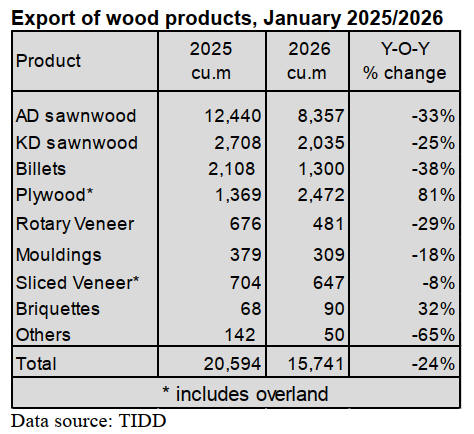
Air-dried and kiln dried sawnwood exports together
accounted for more than 65% of the total export volume in
January compared to 74% registered for same month in the
previous year.
Eucalyptus and gmelia dominated plywood exports which,
together, accounted for 61% to the regional market and
72% to the international market . Other species included
ceiba and acacia mangium.
The main export destination included the US, Cyprus,
Germany, Senegal, the Netherlands, Gambia, Togo and
Burkina Faso. The average unit price of plywood dipped
by 14% from Eur378/cu.m in January 2025 to
Eur325/cu.m in the same period in 2026.
5,200 hectares of forest reserves lost between 2021
and 2024
A recent survey by the Forestry Commission (FC) has
indicated that the total area affected by illegal mining in
forest reserves increased by 5,253 hectares between 2021
and 2024 bringing the overall impacted land to 8,924
hectares as of December 31, 2024.
The report further revealed that the Ashanti Region
recorded the highest level of forest degradation, followed
by the Western North Region, highlighting the growing
pressure on some of the country’s most critical forest
ecosystems.
Addressing the media, the Chief Executive Officer of the
FC, Dr. Hugh Brown, attributed part of the increased
illegality to operational challenges which included the
withdrawal of military support in anti-galamsey operations
during the last quarter of 2024. Dr. Brown also noted that
Ghana’s current forest protection strategies remain
outdated and require urgent modernisation to effectively
tackle illegal mining activities.
The FC’s points to the persistent challenge of safeguarding
Ghana’s forest reserve while illegal mining continues to
expand despite enforcement efforts. To address the
problem requires holistic and stronger logistics, improved
surveillance systems and enhanced collaboration among
security agencies and environmental authorities.
In a related development, the head of the National timber
monitoring team, Alhaji Doku, also noted that “dealing
with the cartels in illegal forest activities calls for
improved logistics for the timber industry to be able to
face off with the unseen hands depleting the country’s
forest illegally and denying government of revenue”.
Illegal mining activities have depleted the country’s forest
cover leading to the dwindling of raw materials for
processing and caused water pollutions due to the crude
and unregulated nature of the mining process.
See: https://citinewsroom.com/2026/03/galamsey-destroys-
nearly-9000-hectares-of-forest-reserves-forestry-commission/
and
https://www.graphic.com.gh/news/general-news/national-timber-
monitoring-team-vows-to-deal-with-cartels.html
Ghana Shippers Authority advices local businesses on
Middle East crisis
The Ghana Shippers Authority (GSA) is cautioning
Ghanaian importers and exporters including timber and
timber products of impending higher shipping costs and
potential delays due to global maritime disruptions
because of the conflict involving the US, Israel and Iran
which started in February 2026.
In a notice to shippers, the Authority said the war has
severely impacted vessels movement through the critical
Strait of Hormuz, used by most international shipping
lines and handles significant volumes of the global
seaborne trade. The disruptions and the far-reaching
consequences for the global supply chain have compelled
many international shipping lines to reroute their vessels.
This is leading to increased operational costs and the
introduction of war risk and emergency surcharges,
estimated to be between US$1,500 and US$2,000 per
TEU, to cover rising insurance and risks. The GSA
clarified that all surcharges are imposed by shipping lines,
not local authorities, and reiterated its regulatory mandate
to ensure fairness in the sector.
Ghana’s timber and wood products trade with the Middle
East market accounts for 3% of total export volume while
the Far East/Asia accounts for 62% to become the leading
market destination.
See: https://www.graphic.com.gh/news/general-news/ghana-
news-gsa-investigates-war-risk-surcharges-amid-global-
shipping-disruptions.html
Agribusiness Chamber pushes for national agenda to
reposition agriculture and forestry
The Chamber of Agribusiness Ghana is urging for a bold,
transformative national agenda to re-establish agriculture,
including timber, as Ghana's primary economic engine to
provide food security and drive industrialisation.
In a statement signed by its Chief Executive Officer,
Anthony Kofituo Morrison the Chamber indicated that
agriculture has been the backbone of Ghana’s economy for
nearly seven decades and the sector continues to
contribute significantly to the Gross Domestic Product
(GDP) and employment but faces structural
competitiveness challenges. The Chamber highlights a
rising food import dependency and massive post-harvest
losses (20-50% of produce) due to inadequate
infrastructure.
The Chamber proposes a Seven-Year National Agriculture
and Agro-Industry Development and Transformation
Strategy with focus on accelerated investments in agro-
industrialisation, agricultural technology, research,
logistics systems and global value chain integration.
This strategy should also be targeted to reduce food import
bills by 60%, cut post-harvest losses by 80% and reduce
food waste by 90% through modern storage, logistics,
processing and integrated food management systems.
Past governments have aimed at industrialisation and
creatation of a skilled employment base needed for
sustainable prosperity. On the occasion of Ghana’s 69th
Independence Day Anniversary, the President noted that
“Ghana must earn more from its natural resource
endowment if we are to create wealth and prosperity for
our people”.
See: https://www.myjoyonline.com/reset-ghanas-economy-
through-agriculture-agribusiness-chamber-on-independence-day/
and
https://thebftonline.com/2026/03/12/mida-moves-to-transform-
volta-corridor-into-agro-industrial-powerhouse/
3. MALAYSIA
CITES proposal on Shorea
Tan Peng Juan, president of the Malaysian Timber
Association, said he had serious concerns over attempts by
the European Union and the United States to propose the
inclusion of more tropical timbers under Appendix II of
CITES at the 20th Conference of the Parties (CoP20).
He said, any proposal to list major traded timber species
like Genus Shorea under CITES should be substantiated
by credible scientific evidence and accurate trade data in
line with the criteria established under the convention.
See: https://woodcentral.com.au/malaysia-warns-cites-push-on-
tropical-timber-is-self-interest-not-science/
MIFF 2026
The Malaysian International Furniture Fair (MIFF) 2026 is
proof that sustainability and innovation can go hand in
hand to create world-class furniture, says Plantations and
Commodities Minister, Dr. Noraini Ahmad. She
commended the MIFF 2026 for showcasing sustainable
and environmentally responsible products and ideas,
which will assist Malaysian furniture makers navigate the
short-term tariff probabilities.
“Malaysia’s certified exporters will be well positioned to
capture premium opportunities. This could pave the way
for a gradual recovery and a more sustainable growth
trajectory beyond the short-term tariff headwinds,” said
Dr. Noraini
“Many of our manufacturers hold internationally
recognised certifications such as the Malaysian Timber
Certification Scheme, endorsed by the Programme for the
Endorsement of Forest Certification. These credentials
position them favourably to access premium ESG-
sensitive markets such as the European Union and Japan,
partially cushioning trade challenges and preserving long-
term competitiveness. We are also actively promoting
alternative sustainable materials, including the utilisation
of oil palm trunk biomass and the expansion of bamboo
cultivation, which transforms waste into valuable
resources,” she said.
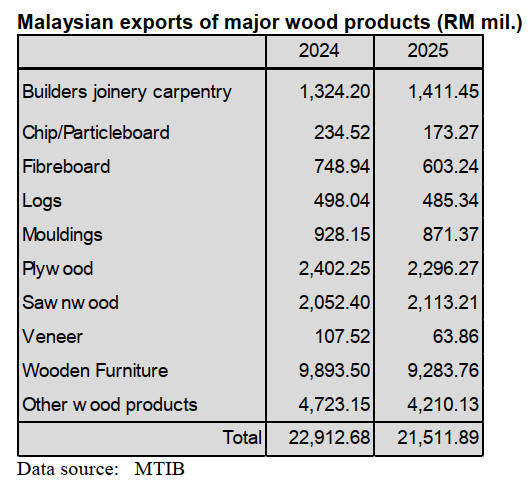
The industry’s exceptional performance has reinforced the
timber industry’s position as the third-largest contributor
to Malaysia’s commodity exports. Overall, Malaysia’s
timber and wood-based product exports are valued at over
RM20 bil. annually, with wooden furniture now
accounting for 43% of total timber exports.
See:
https://www.thestar.com.my/news/nation/2026/03/05/innovation-
sustainability-define-2026-furniture-fair
Higher container charges at Sepanggar Container
Terminal
Sabah business chambers and industry associations have
urged the State Government and Sabah Ports authorities to
suspend implementation of new container charges at
Sepanggar Container Terminal until the temporary action
plan to resolve port congestion is fully implemented.
Representatives of major industry groups expressed
dissatisfaction over the sharp increase in fees effective 1
March this year.
The daily storage charge for a 20-foot container has
increased from RM12 to RM30, while a 40-foot container
now costs RM60 per day. While supporting port upgrades
and expansion efforts, industry players said fee increases
should only be implemented after improvements are
completed or introduced in stages.
See: https://www.dailyexpress.com.my/news/276806/industry-
players-call-for-delay-in-port-fee-hike/
FTA facilitated expansion of trade
Free trade Agreements (FTA) have facilitated expansion
of trade. Malaysia’s exports to member countries of the
Comprehensive and Progressive Agreement for Trans-
Pacific Partnership (CPTPP) rose by 4.7% to RM486.80
billion in 2025 compared with RM464.80 billion in 2024.
The increase was largely driven by higher exports to
Mexico (up 57%), Chile (15.3%), Singapore (8.1%), Viet
Nam (2.6%), the United Kingdom (2.4%), Canada (2.1%)
and Peru (1.6%).
Through the CPTPP, exporters can access non-traditional,
gain preferential access to the UK market, which had
previously been subject to tariffs.
Statistics show that the issuance of Certificates of Origin
(CO) for the CPTPP bloc surged dramatically to 21,993 in
2024 with an export value of RM7 billion compared with
6,230 COs and RM 2.7 billion in exports in 2023.The
CPTPP has 12 member countries.
See: https://theedgemalaysia.com/node/794783
4.
INDONESIA
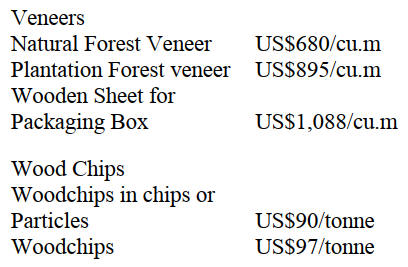
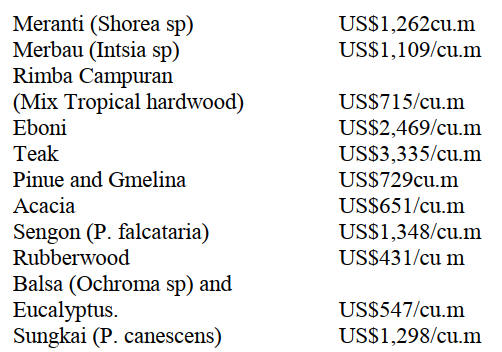
Export benchmark price (HPE),March
2026
The following is a list of Wood HPE from 1 to 31 March
2026.
Processed Wood
Processed wood products which are leveled on all four
sides so that the surface becomes even and smooth with
the provisions of a cross-sectional area of 1,000 sq.mm to
4,000 sq.mm (ex 4407.11.00 to ex 4407.99.90)
Processed wood products which are leveled on all four
sides so that the surface becomes even and smooth of
Merbau wood with the provisions of a cross-sectional area
of 4,000 sq.mm to 10,000 sq.mm (ex 4407.11.00 to ex
407.99.90) US$1,500/cu.m.
See: https://jdih.kemendag.go.id/peraturan/keputusan-menteri-
perdagangan-republik-indonesia-nomor-2139-tahun-2025-
tentang-harga-patokan-ekspor-dan-harga-referensi-atas-produk-
pertanian-dan-kehutanan-yang-dikenakan-bea-keluar-dan-tarif-
layanan-badan-layanan-umum
Strengthening governance with Digital-Based SVLK+
The Ministry of Forestry is strengthening forest product
governance through the digital-based Legality and
Sustainability Verification System (SVLK+).
According to the ministry, SVLK+ is designed to ensure
not only the legality of timber but also sustainability, full
end-to-end traceability, compliance with environmental
standards and transparent supply chain management
through integrated digital systems.
One of its main upgrades is an integrated digital
traceability system that records the entire production
process from upstream forest management to downstream
distribution in an electronic platform that can be
independently verified in real time.
SVLK+ also strengthens sustainability verification by
integrating with the Sustainable Forest Management
Certification (S-PHL), ensuring that forest operations
follow responsible management practices beyond
administrative legality.
The system improves public transparency and
accountability by expanding information access and
reinforcing the role of accredited independent verification
bodies. Additionally, it aligns Indonesia’s timber
governance with international regulations, including due
diligence and anti-deforestation standards to maintain
credibility in global markets.
Through SVLK+ and broader digitalisation, Indonesia
aims to enhance law enforcement, boost international trust
and strengthen its position in global forest product trade.
See:https://m.antaranews.com/amp/berita/5436430/kemenhut-
perkuat-tata-kelola-hasil-hutan-lewat-svlk-berbasis-digital
and
https://rri.co.id/en/business/2211888/indonesia-launches-svlk-
for-ai-timber-monitoring
Indonesia as global furniture manufacturing hub
The Indonesian Ministry of Industry aims to establish the
country as a global hub for furniture manufacturing by
enhancing sustainable wood downstream processing and
strengthening the competitiveness of the national industry.
Over the next five years, Indonesia plans not only to
expand production capacity but also to take a leading role
in design and sustainability.
However, the national furniture industry faces challenges,
including a 3% decline in exports to US$1.85 billion in
2025 and a 6% rise in imports to US$0.82 billion.
Indonesia’s Legality and Sustainability Verification
System (SVLK) provides a strong foundation to ensure
responsible and sustainable production.
To increase productivity the ministry has implemented the
Wood Processing Industry Machinery/Equipment
Restructuring Programme supporting 35 companies with
IDR26.1 billion in reimbursements and achieving notable
improvements in efficiency, product quality and overall
productivity.
See: https://www.antaranews.com/berita/5457571/kemenperin-
targetkan-ri-jadi-hub-produksi-industri-furnitur-dunia
Strategic Indonesia/US partnership
The Indonesian Furniture and Handicraft Industry
Association (ASMINDO) has strengthened sustainable
trade ties with US hardwood exporters following the
signing of the Indonesia–US Agreement on Reciprocal
Tariff (ART) on 18 February 2026. Although the
reciprocal tariff was later overturned by the U.S. Supreme
Court, ASMINDO continues to pursue the partnership to
enhance the competitiveness of Indonesian furniture
exports.
Chairman Dedy Rochimat emphasised that the
collaboration focuses on sustainability and legal
compliance with imported raw materials complementing,
not replacing, domestic timber. The initiative aims to
increase export volumes while keeping value-added
processes such as manufacturing and design within
Indonesia, benefiting local Small and Medium Industries
(SMEs) and the broader national industry.
The partnership seeks to broaden the range of materials
available to Indonesian producers, enabling them to enter
mid-to-high-end market segments with strict material
standards. Beyond simple trade, the cooperation involves
technical exchanges on wood species and quality
standards, as well as networking opportunities between
Indonesian furniture producers and American exporters.
Initial efforts will prioritise understanding materials and
creating a transparent, legal supply chain, forming part of
ASMINDO’s larger vision to elevate Indonesia’s furniture
industry. By integrating American hardwood into various
product categories, from solid wood furniture to crafts, the
initiative is expected to strengthen Indonesia’s
manufacturing capacity while fostering a mutually
beneficial trade relationship with U.S. suppliers.
See:
https://www.kompas.com/properti/read/2026/02/27/092814721/a
smindo-perkuat-rantai-pasok-furnitur-global-lewat-kemitraan-
strategis.
and
https://jakarta.suaramerdeka.com/ekonomi/13416784934/asmind
o-perkuat-kemitraan-strategis-dengan-eksportir-kayu-as-usai-
penandatanganan-art
Eying growth in India and ASEAN markets
Indonesia’s furniture and wooden handicraft industry is
navigating rising global geopolitical uncertainty,
particularly following escalating tensions in the Middle
East .
Rather than retreating, industry players are pursuing more
aggressive expansion strategies at the Indonesia
International Furniture Expo (IFEX) 2026 in Tangerang,
using the event to demonstrate Indonesia’s resilience and
competitiveness in the global market.
While the United States remains the industry’s largest
export market (its share recently rising from 54% to 58%)
the government and industry associations are increasingly
diversifying their target markets. In response to instability
in the Middle East, the sector is shifting focus toward fast-
growing Asian markets, especially India and ASEAN
countries, with officials emphasising the need to reduce
reliance on a single region and expand into new
opportunities.
See:
https://www.kompas.com/homey/read/2026/03/05/181231676/ge
opolitik-bergejolak-industri-mebel-alihkan-fokus-ke-india-dan-
asean?page=all#page3.
IFEX 2026 records US$300 Million in transactions
The Indonesia International Furniture Expo (IFEX) 2026)
concluded successfully after four days from March 5–8,
2026, at ICE BSD City, reaffirming its role as a leading
B2B exhibition for furniture and crafts.
Organised by the Indonesian Furniture Industry and Craft
Association (HIMKI) in collaboration with Dyandra
Promosindo the event attracted strong global participation,
with 13,437 buyers and visitors attending. The exhibition
served as a key platform for Indonesian furniture and craft
businesses to showcase design innovations, flagship
products and strengthen connections with international
buyers. During the event, IFEX 2026 recorded on-the-spot
transactions worth US$300 million.
See: https://mediaindonesia.com/ekonomi/868018/ifex-2026-
ditutup-transaksi-on-the-spot-tembus-us300-juta
Wood pellet production meets sustainable forestry
standards
Indonesia’s Ministry of Forestry has reassured energy
companies that the country’s wood pellet production
follows sustainable forest management standards.
The statement was delivered by Ade Mukadi, Director of
Forest Product Processing and Marketing Development,
during a meeting with representatives from Tokyo Gas
Co., Ltd. and Hanwa Co., Ltd., which purchases wood
pellets from Gorontalo Province. The meeting addressed
concerns from the buyers about potential deforestation
risks associated with the growing global biomass industry.
Officials explained that Indonesia’s forestry governance is
based on key principles including ecological, socialand
economic sustainability; transparency and accountability;
legal compliance; and the protection of community and
indigenous rights.
To ensure these standards are met, the government has
implemented the Timber Legality and Sustainability
Verification System (SVLK), which monitors the legality
and sustainability of timber products throughout the entire
supply chain. Independent certification bodies audit forest
operations, processing industries and trading entities to
ensure traceability from forest to market. The ministry has
also strengthened monitoring through digital technologies
that record harvesting locations, transport documentation
and export permits using geolocation systems and QR
codes.
See: https://ecobiz.asia/indonesia-assures-japanese-buyers-wood-
pellet-production-meets-sustainable-forestry-standards/
Indonesia explains multi-business forestry plan
Indonesia presented its multi-business forestry strategy at
the Global Summit on Advancing Sustainable Forest-
Based Bioeconomy Approaches in Vienna, Austria, an
event attended by representatives from 60 countries and
120 international organizations. The strategy was
introduced as a legally supported framework aimed at
transforming sustainable forest management while
promoting growth in the forest-based bioeconomy.
According to Krisdianto, Director of Forest Product Dues
and Administration at Indonesia’s Ministry of Forestry,
the country’s forest utilisation approach now goes beyond
timber production by incorporating non-timber forest
products, environmental services and nature-based tourism
to expand economic opportunities.
The framework integrates business licensing under the
Forest Utilisation Business License (PBPH), simplifying
the permitting process while maintaining sustainability
safeguards. Krisdianto emphasised that sustainable forest
management requires collaboration among all
stakeholders, particularly those benefiting from forest
resources and reaffirmed Indonesia’s support for the
Vienna Call for Action as a guiding framework for future
global forestry policies.
See: https://rri.co.id/en/environment/2239569/indonesia-
presents-multi-enterprise-forestry-concept-in-vienna
Fostering governance and forest law on the ground
Indonesia’s Ministry of Forestry is intensifying efforts to
strengthen forest governance and law enforcement at the
ground level to ensure sustainable forest management.
Vice Minister, Rohmat Marzuki, highlighted these
priorities during the “Addressing Forest Area
Governance” webinar stressing that the forestry sector is
critical for sustainable development, ecological balance
and community welfare.
He noted that recent hydrometeorological disasters reveal
weaknesses in site-level forest management, underscoring
the need for improved supervision and governance. To
tackle these challenges, the Ministry is promoting
ecosystem-based landscape forest management, enhancing
the One Map policy and establishing Forest Ecosystem
Management Centers at the provincial level to improve
coordination between central and regional authorities.
Measures include creating Law Enforcement and Forest
Fire Control Centers in 24 regions, expanding the forest
police force by 21,000 personnel with a security ratio of
1:5,000 hectares and deploying advanced IT and drone
monitoring to detect deforestation and respond to forest
fires.
See: https://rri.co.id/en/national/2211875/forestry-ministry-
fosters-governance-and-forest-law-on-the-ground
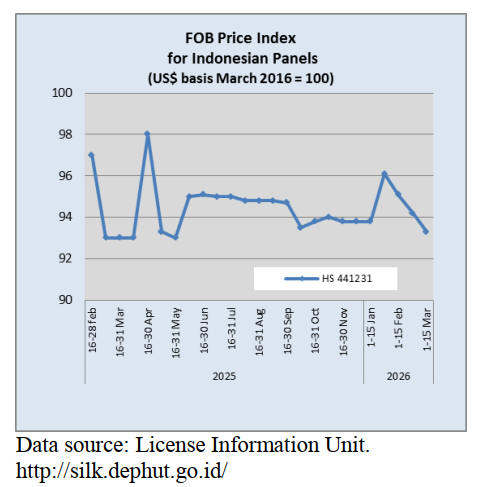
5.
MYANMAR
6.
INDIA
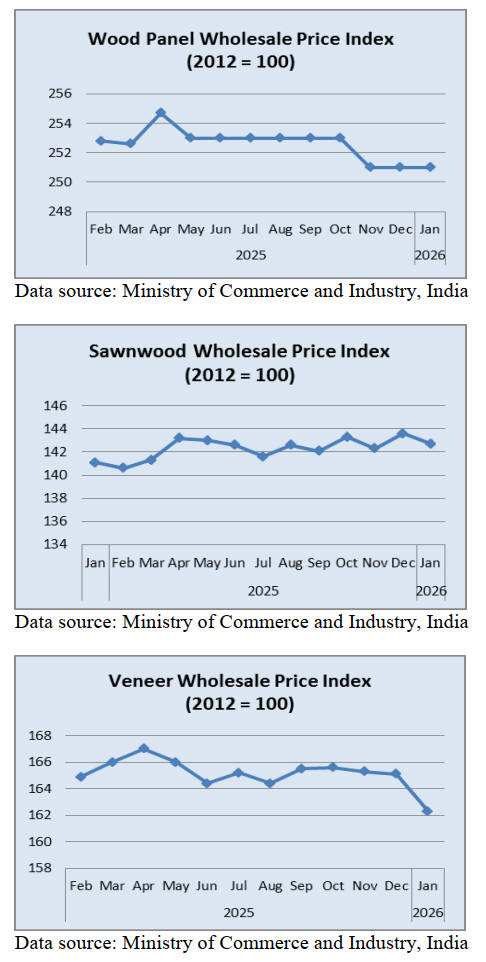
Price indices for sawnwood and veneer
declined
The annual rate of inflation in January, based on WPI, was
1.81%, a positive year on year increase driven mainly by
rising prices of basic metals, manufacturing, non-food
articles, food articles and textiles. The overall WPI index
increased from December 2025 to January 2026 by 0.51%,
reflecting a moderate month on month rise. The Primary
Articles group saw a slight decrease in index and inflation,
with food articles and minerals experiencing price
declines, while non-food articles and crude petroleum and
natural gas prices increased.
The Manufactured Products index experienced a 1.30%
increase with most sub-groups, including basic metals,
food products, textiles and electrical equipment,
witnessing price rises; pharmaceuticals, machinery and
furniture saw decreases. The Wood Panel index in January
was unchanged from a month earlier but the indices for
sawnwood and veneer declined with the price index for
veneer showing a steep drop. The press release indicates a
modest rise in wholesale prices in India for January 2026,
driven by increases in manufacturing and certain
commodity groups, despite declines in fuel and power
prices. The inflation trend shows signs of recovery after
recent deflationary periods.
See: https://eaindustry.nic.in/
and
chrome-
extension://efaidnbmnnnibpcajpcglclefindmkaj/https://eaindustry
.nic.in/pdf_files/cmonthly.pdf
Mills welcome improved availability of poplar
logs
North India based plywood industry is set to regain its
charm following an improvement in the availability of
Poplar logs to the industry. After a gap of 6 to 7 years the
plywood industry in North Inda is looking forward to a
steady supply of plantation of poplar logs.
A recent survey conducted by Ply Reporter found the
industry reported the arrival of sufficient volume of poplar
logs over the last 4 months and that prices have also eased.
Ply Reporter adds, the supply of imported pine core logs to
North India mills has declined.
The Improving supply of poplar plantation logs is
motivating plywood markers to increase the productiono.
Owners of plywood mills in Punjab and Yamuna Nagar
feel that increasing supply of poplar plywood is driving
the demand of economical grade plywood in state of
Maharashtra, Gujarat, Rajasthan, MP, Punjab and Delhi.
India is one of the largest plywood markets in the world,
with a growth rate that reflects the nation’s healthy
construction and real estate sectors with the plywood
industry being a critical part of the building materials
economy.
The key drivers of sector growth have been expansion of
urban housing projects, developments in modular furniture
and interior décor production, demand for safe and
environmentally sound building materials and government
infrastructure developments.
See: https://www.plyreporter.com/article/154262/full-poplar-ply-
returns-in-north-india
and
See: https://architectureply.com/blogs-detail/exploring-the-
booming-plywood-industry-in-india
Demand characterised by a shift toward premium
housing
India's residential real estate market in 2025 ,while seeing
an 11% decline in total sales demonstrated remarkable
resilience and strategic evolution characterised by a shift
toward premium housing segments. Sales in Hyderabad
and Chennai outperformed while Mumbai and Pune
experienced significant sales weakness.
The year was marked by a focus on up market sector
growth with properties above INR 10 million expanding
and developers concentrating on higher price and higher
margin projects.
See: https://www.jll.com/en-in/insights/market-dynamics/india-
residential
Updated figures lower GDP
Revisions to India’s GDP data has revealed it will take
longer than expected to surpass Japan as the world’s
fourth-largest economy. The government updated GDP
figures using a new base year estimating the size of the
economy at 345.47 trillion rupees, in nominal terms, for
the fiscal year ending this month. This is lower than
forecast under the previous data series.
Using an average exchange rate for the period, GDP is
estimated at about US$4 trillion for the fiscal year. Japan’s
GDP reached US$4.4 trillion in 2025.
The Prime Minister Narendra Modi and several senior
government officials already refer to India as the world’s
fourth-largest economy. The International Monetary Fund
had previously forecast that India would reach that
milestone in the current fiscal year. That is now unlikely
as India’s currency depreciated sharply.
However, the trend is clear as India’s economy is
expanding fast and its population is growing. In contrast
Japan’s economic growth is much slower and its
population is shrinking.
See:
https://www.japantimes.co.jp/business/2026/02/28/economy/indi
as-gdp-revisions-japan-economy/
title
A Central government circular that allows private entities
to establish plantations on forest land has critics warning
of biodiversity loss and the exclusion of traditional
communities.
The government justifies the decision as “an effort to
align with the evolving framework for restoration of forest
land and utilisation of silviculturally available sustainable
harvest from forests”.
Ritwick Dutta, an environmental lawyer and founder of
the Legal Initiative for Forest and Environment argued
that the interchangeable use of the terms “afforestation”
and “plantations” in the circular dilutes a recognised legal
and ecological distinction.
“Afforestation is intended to restore natural forest
ecosystems, plantations are commercial and monocultural
crops meant for harvesting. “This conflation undermines
the statutory objective of conservation by permitting
economically driven activities to be justified as ecological
restoration,” Dutta said.
See: https://frontline.thehindu.com/environment/india-forest-
policy-private-plantations/article70528235.ece
7.
VIETNAM
Wood and wood product (W&WP) trade
hightlights
According to the Viet Nam Customs Office, Viet Nam’s
W&WP exports in February 2026 were valued at US$1
billion, down 38% compared to January 2026 and down
3% compared to February 2025. WP exports were US$676
million, down 36% compared to January 2026, but up
0.4% compared to February 2025.
In the first 2 months of 2026 W&WP exports amounted to
US$2.6 billion, up 6% over the same period in 2025. WP
exports contributed US$1.7 billion, up 4% over the same
period in 2025.
Viet Nam's office furniture exports in February 2026
totalled US$18.5 million, down 37% compared to January
2026 and down 12% compared to February 2025.
In the first 2 months of 2026 exports of office furniture
generated US$48 million, down 6% over the same period
in 2025.
W&WP exports to the Canadian market in February 2026
amounted to US$19 million, down 38% compared to
January 2026, but up 15% compared to February 2025.
In the first 2 months of 2026 W&WP exports to Canada
are estimated at US$49 million, up 13% over the same
period in 2025.
Viet Nam's W&WP imports in February 2026 reached
US$200 million, down 37% compared to January 2026
and down by 4% compared to February 2025. In the first 2
months of 2026 W&WP imports were valued at US$517
million, up 27% over the same period in 2025.
Ho Chi Minh HawaExpo 2026 triples in scale
Under the theme “Gateway to Viet Nam Furniture
Prowess” and featuring more than 2,500 booths the four-
day event served as a gateway to exploring the genuine
capabilities of Viet Nam’s wood and furniture industry, as
well as a strategic trading hub for international markets.
Departing from the traditional exhibition model,
HawaExpo 2026 distinguishes itself through its
organisational structure. Rather than focusing primarily on
display, the event has been designed as a “value journey”
built upon the four strategic pillars of trade, design, green
transformation and technical innovation.
This in-depth approach reflects a determination to address
the sector’s core challenges, including market expansion,
value-added upgrading, compliance with green standards
and productivity enhancement. Phung Quoc Man,
Chairman of the Handicraft and Wood Industry
Association of Ho Chi Minh City (HAWA), underscored
that the fair’s distinctive feature lies in the high level of
domestic value embedded in made-in-Viet Nam wood
products. Nearly 90% of the exhibition space is devoted to
showcasing furniture manufactured in the country.
Speaking at the opening ceremony, Nguyen Quoc Tri,
Deputy Minister of Agriculture and Environment, noted
that the increasing professionalisation of the HawaExpo
has made a positive contribution to the industry’s
impressive exports of over US$18.3 billion in wood and
forestry products. Against a backdrop of volatile global
trade the fair stands as a symbolic trade promotion event
affirming the position and resilience of the sector on the
international stage.
Nguyen Van Duoc, Chairman of the Ho Chi Minh City
People’s Committee, said that over its three editions,
HawaExpo has successfully established a reputable brand
contributing to the broader development of the wood
industry business community, not only in the city but
nationwide.
See: Ho Chi Minh City’s HawaExpo 2026 triples in scale | Viet
Nam+ (Viet NamPlus)
and
Timber sector grows rapidly without compromising forest
resources
VIFA EXPO 2026 - 650 exhibitors and 2,500 booths
across two major venues
The event took place simultaneously at two major
exhibition venues in southern Viet Nam - WTC EXPO in
Binh Duong Ward and SKY EXPO in Trung My Tay
Ward, Ho Chi Minh City. More than 3,000 international
visitors from over 18 countries and territories participated
in this year’s event, further reinforcing Viet Nam’s
growing prominence on the global wood and furniture
trade map.
Alongside trade activities, organisers also launched
the
VIFA EXPO 2026 Creative Furniture Showcase. The
initiative encourages Viet Namese indoor and outdoor
furniture manufacturers to move beyond outsourcing
toward higher-value creation through original design and
product development.
VIFA EXPO 2026 served as a premier face-to-face
networking hub connecting international buyers with
VienNamese furniture manufacturers.
With the participation of leading enterprises and dedicated
programmes designed for international buyers the event
aims to maximise the effectiveness of every business visit
while fostering long-term partnerships.
See: https://Viet Namnet.vn/en/vifa-expo-2026-expands-with-
record-scale-and-global-participation-2495257.html
Forest carbon market - a new financial channel for
sustainable forestry
The development of a forest carbon market is opening up
significant opportunities for Viet Nam’s forestry sector to
mobilise new financial resources for forest protection and
development, while creating sustainable livelihoods for
local communities, particularly in ethnic minority areas.
Initial outcomes from the forest carbon payment
mechanism highlight the sector’s strong potential to align
forest conservation with economic benefits and sustainable
development goals.
According to Pham Hong Luong, Deputy Director of the
Viet Nam Administration of Forestry and Forest
Protection under the Ministry of Agriculture and
Environment, the implementation of forest carbon
payments through the Emission Reductions Payment
Agreement (ERPA) for the north central region has
generated tangible socio-economic and environmental
impacts.
Viet Nam has received US$56.5 million under the
programme which has directly supported more than
77,700 households and nearly 2,000 communities engaged
in forest protection activities, including over 40,000 ethnic
minority beneficiaries.
Money earned from forest carbon has boosted local
livelihoods and been funneled into rural infrastructure,
improving living standards and empowering communities
in managing forests. As people see direct benefits from
keeping forest cover, their sense of responsibility for forest
resources has grown, helping cut down on forestry law
violations.
According to Luong, the programme has also helped
protect more than 2.15 million hectares of natural forest in
the region, maintaining forest coverage at around 57%.
Recognising the vast potential of the forest carbon market,
the forestry sector is rolling out comprehensive measures
to manage and effectively leverage this resource.
Completing the legal framework is a priority, drafting a
decree on forest carbon absorption and sequestration
services and the national forest carbon standards. These
steps are essential to ensuring transparent measurement,
management and trading of forest carbon credits in line
with international practices.
As Viet Nam has committed to achieving net-zero
emissions by 2050, the forest carbon market is to become
a key instrument for mobilising domestic and international
resources for forest protection.
With promising initial results and systematic preparations,
the forest carbon market is gradually establishing itself as
a vital financing channel, laying the foundation for a
modern, efficient and sustainable forestry sector.
See: https://en.Viet Namplus.vn/forest-carbon-market-
constitutes-new-financial-channel-for-sustainable-forestry-
post338822.vnp#:~:text=Environment-
,Forest%20carbon%20market%20constitutes%20new%20financi
al%20channel%20for%20sustainable%20forestry,benefits%20an
d%20sustainable%20development%20goals
8. BRAZIL
Engineered wood - a sustainable
alternative in
construction
Engineered wood has been gaining ground as a lower
environmental impact alternative in the construction sector
which has traditionally been associated with high carbon
dioxide emissions due to the extensive use of steel and
concrete. Unlike those materials, wood captures carbon
during tree growth and keeps it stored within building
structures throughout their service life.
Studies indicate that buildings made with engineered wood
emit up to 80% less CO₂ per square metre compared to
concrete and masonry structures. Technological advances
have expanded the possibilities for using this engineered
wood products through industrialised production systems
such as for glued laminated timber (Glulam) and cross
laminated timber (CLT) which can meet contemporary
structural requirements.
In Brazil, the structural use of wood is primarily regulated
by ABNT NBR 7190, complemented by Standards related
to durability and building maintenance. In addition to
environmental benefits, engineered wood offers several
construction advantages including lower structure weight,
reduced loads on foundation, greater industrial precision
and less waste generation at construction sites as well as
contributing to faster and more predictable construction
processes.
When sourced from forests managed sustainably the
material also allows buildings to function as carbon
reservoirs, reinforcing their role in climate change
mitigation strategies.
However, sustainable use depends on certified supply
chains, proper forest management and strict compliance
with technical standards. When these elements are aligned,
engineered wood represents a synthesis of tradition and
innovation, a long-established material reinterpreted by
contemporary engineering to address one of the greatest
challenges of our time.
See: https://www.maisfloresta.com.br/como-a-madeira-
engenheirada-pode-mudar-cidades/
Low-impact forest harvesting increases carbon stock
capacity
The adoption of reduced-impact logging forest
management (RIL) contributes to the structural recovery
of tropical forests and increases long-term carbon stocks
according to research published in the Journal of
Environmental Management.
The study analysed experimental forest plots over a 30-
year period (1993–2023) in the municipality of
Paragominas, Pará State in the Amazon region, comparing
three conditions: reduced-impact management,
conventional logging and an unlogged control area.
During this period regular measurements of tree diameter
and estimates of above-ground biomass were conducted
for different species groups, including harvested species,
species with commercial harvesting potential and non-
commercial species.
The results indicate that areas managed using reduced-
impact techniques showed a positive biomass balance,
with an average gain of 70.68 Mg per hectare, approaching
the structure of mature forests and reaching average stocks
of up to 353.42 Mg per hectare. In contrast, areas
subjected to conventional logging recorded biomass
losses, with a negative balance of 11.35 Mg per hectare,
while the control area remained practically stable.
These findings suggest that planned, low-impact
management practices promote forest regeneration and
increase carbon sequestration while also reducing damage
to remaining vegetation and maintaining biodiversity and
ecosystem services.
The results reinforce the potential of sustainable forest
management as a strategy to reconcile timber production,
environmental conservation and climate change
mitigation. In addition, SFM contributes to the
development of methodologies associated with payments
for ecosystem services and carbon markets including
initiatives linked to REDD+ and Improved Forest
Management.
See: https://www.maisfloresta.com.br/manejo-com-reducao-de-
impacto-e-capaz-de-promover-recuperacao-de-floresta-e-estocar-
carbono/
Pará State timber exports in 2026
Timber exports from the State of Pará, in the Amazon
Region began 2026 with strong growth. According to
Comex Stat, from the Ministry of Development, Industry,
Foreign Trade and Services (MDIC), Pará State exported
US$23.6 million in wood products in January 2026, a
106% increase compared to the same period in 2025.
In volume terms, shipments increased from 22,800 tonnes
to 23,700 tonnes while the average price per tonne nearly
doubled, rising from US$502 to US$ 1,003 in January
2026.
Among the main exported products exported, profiled
wood stands out, commonly used in flooring, decking,
parquet and moldings, whose exports increased from
US$4.4 million to US$16.4 million. Sawnwood also
recorded a significant increase of 60% in value, totalling
US$5 million in exports.
On the other hand, some segments experienced a decline
such as roundwood, which recorded a 41% drop in value
and 36% in volume, in addition, exports of fibreboard,
plywood and other wood-based products including
furniture declined.
The US was the main destination for timber from the State
of Pará with a 300% increase in purchases and accounted
for 39% of the State’s exports.
There was also significant growth in sales to European
countries, particularly the Netherlands (up almost 250%),
France (47%) and Denmark (200%). In contrast, India
recorded a decline of 35% in imports from the State.
At the national level, Pará was the only State among the
main exporting states to show significant growth. While
Brazilian timber exports fell by 17% in value in January
2026, Pará more than doubled its export revenue during
that period. States such as Paraná (-36%), Santa Catarina
(-16%) and São Paulo (-29%) recorded declines.
According to the Brazilian Association of Timber
Exporting Industries (AIMEX), this performance
demonstrates an important recovery in the international
market, especially in the United States and the European
Union. Despite the positive results, challenges remain
related to geopolitical uncertainties and international
regulatory requirements, such as the European Union
Deforestation-Free Products Regulation (EUDR).
See:
https://www.portalolavodutra.com.br/materias/exportacoes_de_
madeira_do_para_comecam_2026_em_alta_e_crescem_106_em
_janeiro
Reduction of US tariff may boost the timber sector
The recent US tariff review has increased the likelihood of
a resumption of Brazilian timber exports to the US. The
US announced the application of a global tariff of up to
15% on imports based on Section 122 of the Trade Act of
1974, a provision that allows the temporary imposition of
tariffs without Congressional approval for up to 150 days.
Within the production sector the prevailing assessment is
one of caution considering the frequent changes in trade
decisions adopted by the US. The Union of Sawmill,
Carpentry, Cooperage and Woodworking Industries of
Ponta Grossa (Sindimadeira) notes that reducing tariffs to
levels between 10% and 15% could restore part of the
competitiveness of Brazilian timber in relation to other
exporting countries.
In previous decisions related to Section 232, some
products had their tariffs reduced from 40% to 10%, which
allowed a partial resumption of exports.
However, items such as moldings, fences and plywood
remained subject to tariffs between 40% and 50%, limiting
the recovery of the segment’s foreign trade.
The sector is still facing the impact of previous tariffs,
reflected in commercialisation difficulties and recent
layoffs according to Sindimadeira. Nevertheless, if tariff
rates stabilise at lower levels the expectation is for a
gradual recovery in the competitiveness of Brazilian
timber in the US market.
See: https://arede.info/ponta-grossa/627954/reducao-de-tarifas-
nos-eua-pode-impulsionar-setor-madeireiro-de-pg-e-regiao
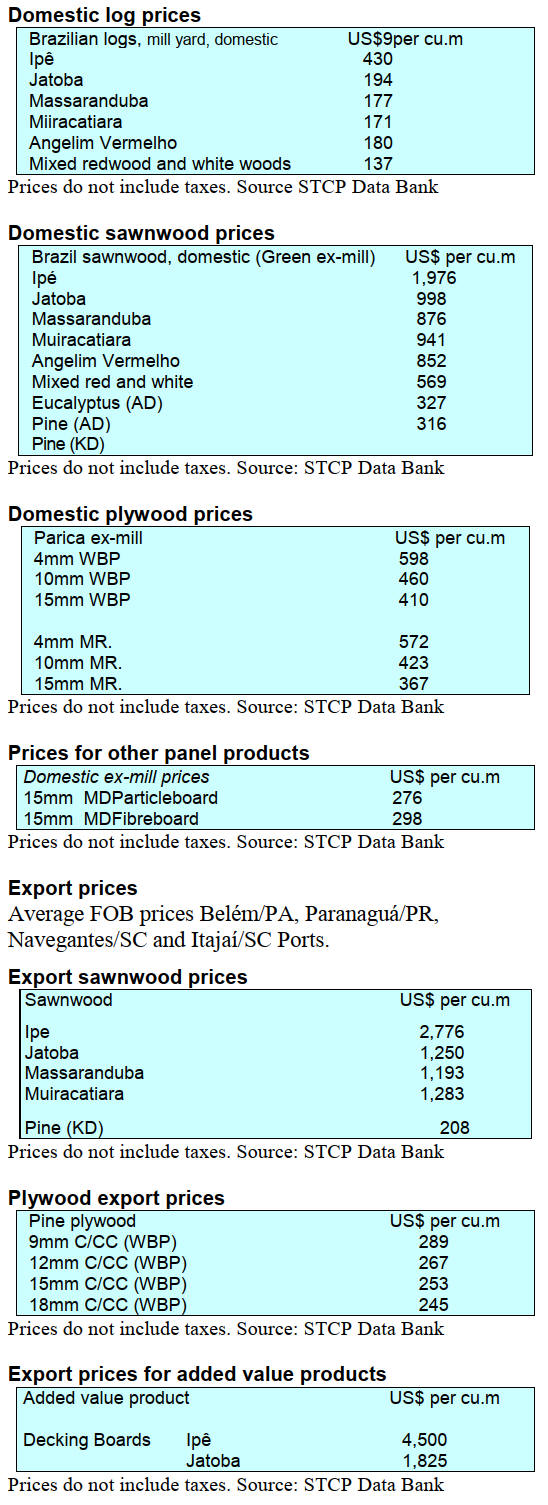
9. PERU
2025 exports down almost 18%
Peruvian wood product exports totalled US$69.9 million
in 2025 reflecting a 17.7% decrease compared to 2024
(US$85.1 million) according to the Center for Research on
Global Economics and Business of the Association of
Exporters (CIEN-ADEX).
According to figures from the ADEX Data Trade Business
Intelligence System, exports included semi-manufactured
products (US$27.1 million), sawnwood (US$22.9 million),
fuelwood and charcoal (US$5.8 million), furniture and
furniture parts (US$4.7 million) and construction products
(US$4.1 million).
The leading destination in 2025 was France with
shipments totalling US$11.6 million, a 17% decrease
compared to the previous year. The Dominican Republic
followed with US$10.3 million, a decrease of 8%
compared to 2024. The United States came in third with
US$10.2 million, a decrease of 15%, followed by China
with US$7.1 million, a decrease of 37% and rounding out
the top five was Mexico with sales of US$6.4 million, a
decrease of 37%.
Exports of Furniture and parts
According to information provided by the Services and
Extractive Industries Management of the Association of
Exporters (ADEX), shipments of furniture and furniture
parts in 2025 reached a FOB export value of US$4.7
million, a decrease about 1% compared to the same period
in 2024.
The main market for exports for this subsector was the
United States, which accounted for 54% of the total
followed by Italy with 8%. Chile ranked third with 8%
then Antigua and Barbuda in fourth place with 6% and the
Dominican Republic rounding out the top five with 5%.
Eucalyptus potential for furniture manufacturing
The use of sawn Eucalyptus urograndis (a fast-growing,
high-yield hybrid of E. grandis and E. urophylla, widely
cultivated in Brazil for pulp, paper and energy production)
is emerging as a viable timber for furniture manufacturing
according to a study from the CITEforestal Pucallpa
laboratory of the Technological Institute of Production.
The study was undertaken for Sociedad Agroindustrial
Blue S.A.C. As part of this initiative both institutions
presented four furniture prototypes made from 5 year old
Eucalyptus urograndis.
According to the results obtained, the five-year-old logs
showed better yield levels, greater uniformity and few
defects which allowed for the validation of their structural
and functional behavior as well as their mechanical
resistance.
Subsequently, the stages of felling, sawing and yield
analysis were developed evaluating the process from
standing tree to sawn timber, including drying.
In addition, technological studies were conducted at the
four evaluated ages and in parallel, the design and
manufacture of the furniture was carried out.
See: https://www.gob.pe/institucion/itp/noticias/1361983-
ucayali-madera-de-eucalipto-demuestra-potencial-para-la-
fabricacion-de-mobiliario
FSC Peru reports 97 certified initiatives as of February
2026
The Forest Stewardship Council Peru, in its report of
February 28 of this year reported that it is expanded its
presence in the country surpassing one million certified
hectares. The report stated that the country has 97 private
initiatives certified by the FSC, primarily in the timber and
paper sectors. Of these, 86 focus on chain of custody and
11 on forest management.
See: https://www.gob.pe/institucion/osinfor/noticias/1361162-
madre-de-dios-concentro-mas-del-50-de-la-supervision-forestal-
durante-el-2025
|