Japan
Wood Products Prices
Dollar Exchange Rates of 10th
December
2025
Japan Yen 155.58
Reports From Japan
Press release - “Comprehensive Economic
Measures
to Build a Strong Japanese Economy”
This includes a statement of intent on harnessing regional
growth potential and stabilising everyday life which will
be achieved through support for and the revitalisation of
key industries that sustain local living environments,
including medical and nursing care, local transportation
and logistics, retail and services and tourism.
Support will be provided to mid-sized enterprises for
fostering industrial clusters to create world-leading
technologies and businesses originating in local regions.
The government will work to realise a community-based,
inclusive society by strengthening support systems for
people facing economic hardship and enhance safety and
security measures.
In addition, the government will reinforce responses to
issues related to foreign nationals in Japan and pursue
the revitalisation of public education and measures to
advance toward making education effectively free.
A further aim is creating an environment that enables
wage increases, particularly for small- and medium-sized
enterprises and micro-businesses.
To achieve this the press release says the government will
expand provision of the Priority Support Local Allocation
Grant and create an environment that enables wage
increases at companies, including SMEs and small-scale
businesses, that are unable to make use of the tax
incentives that have been introduced to promote wage
hikes.
The government will also ensure thorough price pass-
through and fair business practices and will intensify
support for capital investment aimed at enhancing the
earning power of mid-sized and small and medium sized
enterprises and bolster our support to facilitate business
succession and mergers and acquisitions while also
strengthening hands-on, ongoing support structures.
The government is aware local governments are now
implementing measures to address rising prices in a
manner in line with local needs. To support these
measures the government will expand provision of the
Priority Support Local Allocation Grant. While
maintaining existing initiatives supporting households and
business operators, the government will also
advance additional measures to address the sharp rise in
food prices.
To reduce the burden imposed by energy costs and related
expenses the government will provide assistance to
reduce electricity and natural gas bills during the winter
months having the most severe cold (for usage between
January and March).
For the full statement see:
https://japan.kantei.go.jp/ongoingtopics/sogokeizaitaisaku2025/i
ndex.html
Hint of a rate increase from Bank of Japan
Bank of Japan (BoJ) Govenor, Kazuo Ueda, delivered
hawkish remarks early this month saying “the Bank of
Japan sees the probability that the baseline outlook for the
economy and prices will be realised” which has been
widely interpreted as a rate hike signal. Despite wanting to
normalise interest rates the BoJ has been holding off since
rates rose to 0.5% in January.
At its upcoming Policy Board meeting later this month a
rate increase is anticipated and the longer term policy may
include as many as four rate increases by 2027 according
to Hideo Hayakawa a former executive director of the
Bank of Japan. If the rate increase is implemented
it would be the first since January 2025 and will lead to a
level (anticipated to be 0.75%) not seen since 1995.
With the Bank set to debate raising its policy rate to 0.75%
later this month Prime Minister Sanae Takaichi's
government is showing little opposition to an increase in
borrowing costs.
See:https://www.japantimes.co.jp/business/2025/12/11/economy/
boj-ex-director-multiple-rate-hike-projection/
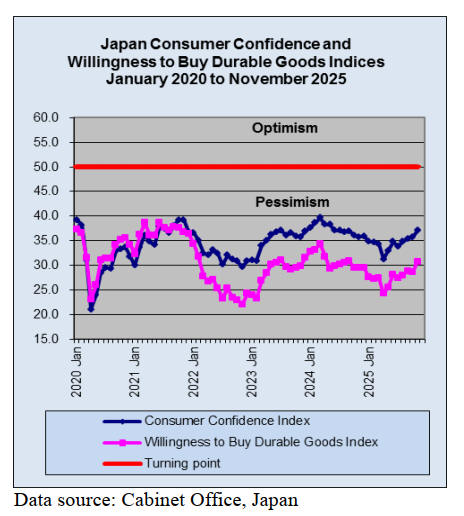
Gradual recovery in household spending
In December 2025 prospects for Japan's household
spending point to a continued gradual recovery supported
by declining inflation and improving income conditions.
However, consumer caution remains a limiting factor with
a sharp recent contraction highlighting underlying
fragility.
Yen/US dollar exchange rate influenced by
interest rate
differentials
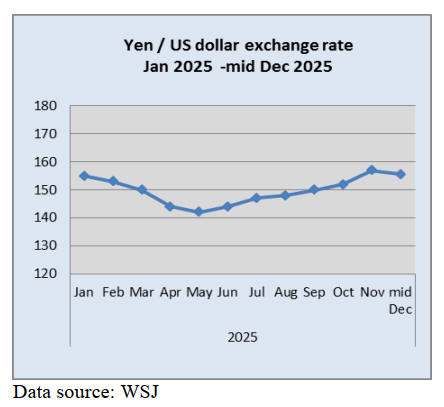
As interest rates rise there could an increase in prices.
With the yen per dollar remaining in the 154-158 range
import prices stay high stimulating overall price rises.
However, the Bank of Japan anticipates a certain brake on
the weakening yen if the interest rate gap between the US
and Japan narrows. The Japanese yen/US dollar exchange
rate is influenced by interest rate differentials between
the US Federal Reserve (Fed) and the Bank of
Japan (BoJ). With the BoJ signalling steady rate increases
against a dovish Fed factors such as US payrolls, BoJ
policy shifts and global risk sentiment (yen as safe haven)
will be key drivers of exchange rate movements in the
coming months.
Growing interest in quality pre-owned properties
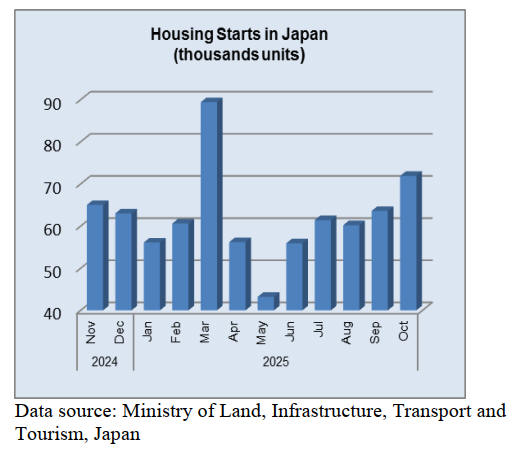
Japan's long-term housing starts have been declining due
to population decline and are projected to fall from
around 800,000 units in the early 2020s to 600,000-
700,000 by the 2030s-2040s with 2025 projections around
785,000, supported by stable interest rates but challenged
by high vacancy rates and shifts towards existing homes.
Key issues are the shrinking working-age population,
increasing vacant homes and a growing preference for
quality pre-owned properties, alongside government
pushes for energy-efficient Net Zero Energy Houses
(ZEH).
A ZEH dwelling is one that that contributes to realisation
of carbon neutrality by introducing renewable energy such
as photovoltaics thereby to make the annual energy
income and outgo to zero after achieving energy efficiency
through improved thermal insulation performance.
20% of materials from World Expo to be re-used
The Japan Association for the 2025 World Exposition
aims to reuse over 20% of the total materials in the
pavilion structures. While non-reusable items, including
exhibits, will become waste, which will be recycled.
Timber from the external walls of the Japan Pavilion will
be reused by municipal governments and educational
facilities.
See: https://japannews.yomiuri.co.jp/editorial/political-
pulse/20251206-296710/
Import update
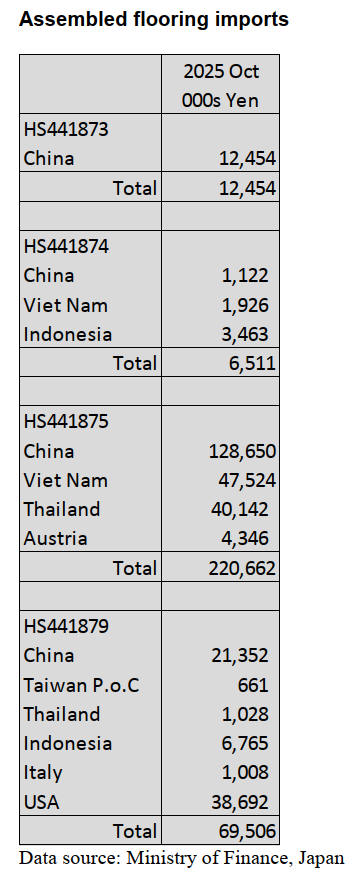
Assembled wooden flooring imports
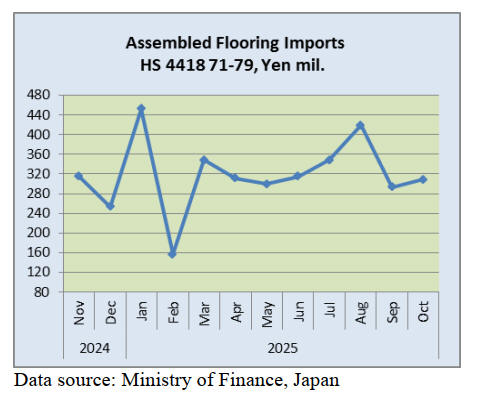
The 3 months of steady increases in the value of imports
of assembled wooden flooring (HS441871-79) ended in
September but the value of imports reversed again rising
in October. Year on year the value of October 2025
imports was at around the same level as in October 2024
and month on month there was a modest 5% increase in
October.
Of the various categories of assembled flooring imports in
October 72% was of HS 4418-75 with China and Vietnam
being the top shippers. For the other categories HS4418-79
accounted for 22% in October (13% in September)
followed by HS4418-73 4% (11% in September) and
HS4418-74 2% (5% in September).
For HS4418-73 imports all originated in China. Shippers
in China and Indonesia were the main shippers of
HS4418-79 arrivals in October with the others suppliers
being Viet Nam, Thailand and Austria.
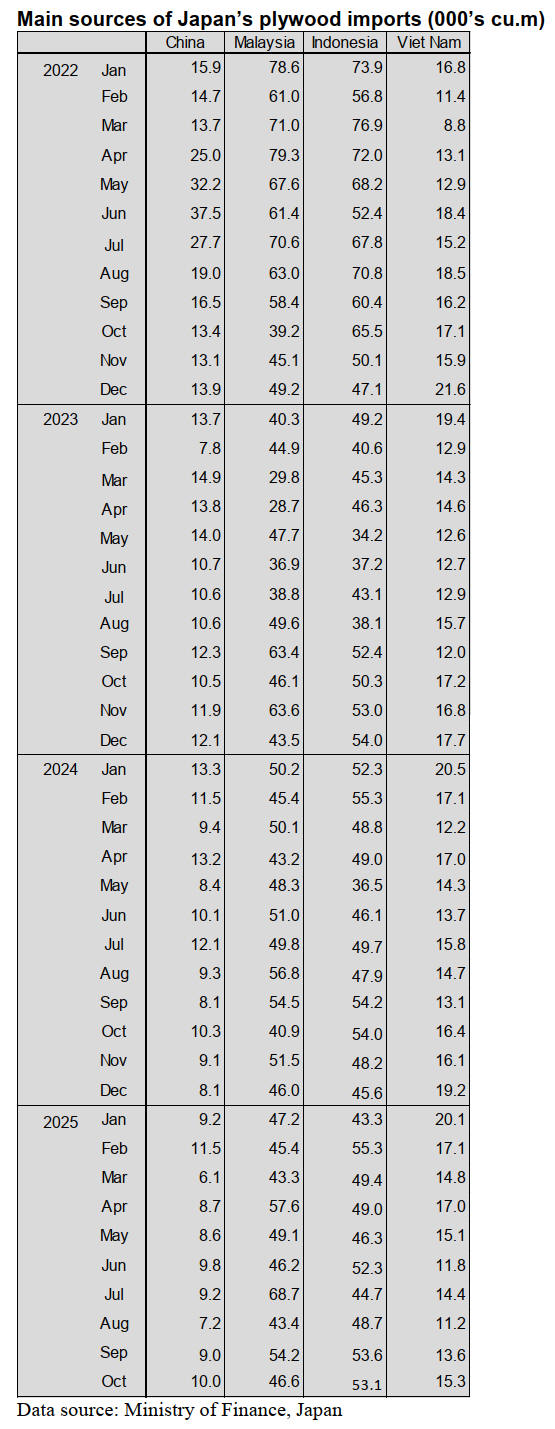
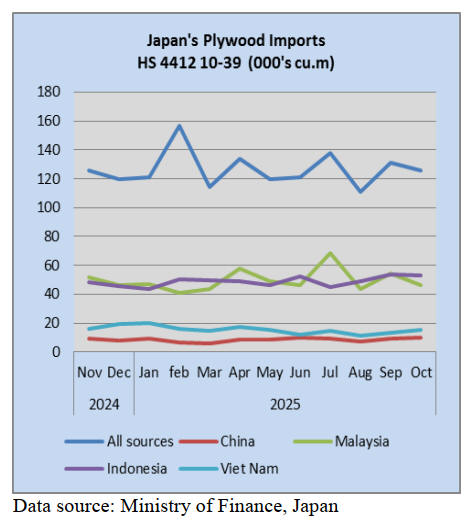
Indonesia and Malaysia were the top suppliers of plywood
to Japan in October and the combined volume of
shipments accounted for 79% of Japan’s plywood imports,
the other top shipper being Viet Nam and China.
October 2025 plywood arrivals were slightly down
compared to the volume of September with Shippers in
Malaysia posting the largest deline.
In October 2025 arrivals of HS441210-39 were reported at
215.755 (131,017 cu.m in September). As in previous
months of the various categories of plywood imported in
October 2025 HS441231 accounted for most followed by
HS441233 and HS441234 with the balance being
HS441239.
Trade news from the Japan Lumber Reports (JLR)
The Japan Lumber Reports (JLR), a subscription trade
journal published every two weeks in English, is
generously allowing the ITTO Tropical Timber Market
Report to reproduce news on the Japanese market
precisely as it appears in the JLR. For the JLR report
please see: https://jfpj.jp/japan_lumber_reports/
Orders for house builders
In October 2025, the order amounts of major housing
manufacturers and builders varied widely. Despite
achieving year-on-year gains, housing firms have yet to
feel a clear recovery in the market. October 2024 was
marked by order amounts that stood out for surpassing or
nearing 100% compared with the same month a year
earlier.
Relative to that time, October 2025 is expected to see few
firms achieving substantial growth in the number of units
ordered, though the average sales price per unit has
increased. Higher sales prices contributed to October 2025
figures surpassing the level of the previous year’s month.
For certain housing firms, performance fluctuates from
month to month, preventing a steady flow of orders.
According to some housing firms, October’s performance
faltered as a rebound effect from the relatively favorable
results in September. In November, certain housing firms,
in contrast, were able to sustain a stable order flow.
Although custom housing orders have been hard to obtain,
certain firms have expanded sales of subdivision homes.
In the case of subdivision housing, higher sales prices
were one background factor, yet regional strategies and
unique product development also played a role in driving
performance.
Cedar KD foundation lumber hits market
Xyence Corporation will begin full-scale sales of
domestically sourced preservative-treated cedar KD
foundation materials to meet low-cost demand.
Traditionally, domestic demand has been met with
Japanese cypress, while low-cost needs have been
addressed with U.S. hemlock. However, both are currently
being overshadowed by untreated cypress foundation
materials, which offer stronger price competitiveness. By
Promoting cedar KD preservative-treated foundation
materials made from domestic timber as the most
affordable option, Xyence aims to stimulate growth in the
preservative-treated foundation market.
This foundation is manufactured by deeply impregnating
incised cedar KD lumber with the oil-based preservative
“Sunpreser OP Ace.” The product has obtained AQ2
certification (equivalent to JAS K3) from the Japan
Housing and Wood Technology Center.
The embedding strength is 6.0 N/mm², which is
comparable to that of American hemlock. The company is
also promoting the expansion of preservation treatment
demand for components other than the foundations such as
columns, studs, window frames, panels, and secondary
members—particularly around the first-floor structure.
Last year, all manufacturing sites obtained AQ2
certification for laminated cedar posts
Adapting to larger non-residential wooden projects
West Forest Products has added new 150 mm and 180 mm
widths to its lineup of high-strength Douglas fir lamina for
the Japanese market. Amid the increase in large non-
residential wooden construction projects, the company
responded to the demand for wider lamina.
Two years ago, the company began supplying high-
strength Douglas fir lamina, anticipating that the increase
in medium-and large-scale wooden construction would
require stronger laminated timber. The company handles
lamina for lintels in widths of 105 mm and 120 mm,
selling them to domestic laminated timber manufacturers.
Although the company initially conducted trial sales, it
now operates under quarterly contracts, with monthly sales
volumes reaching the level of 1,700 to 1,800 cbms. As
projects grew larger in scale, laminated timber
manufacturers had been voicing demand for lamina wider
than 120 mm.
Until now, laminated timber manufacturers had been
cutting 2x8 and 2x10 lamina to meet demand, but this led
to rising production costs and poorer yield.
With the addition of these new variations, further
expansion in the use of high-strength lamina is expected.
Plywood
Domestic softwood structural plywood shipments have
remained steady since September, though market prices
continue to move weakly.
Domestic softwood structural plywood (12 mm, 3×6) is
quoted at ¥1,080–1,100/sheet (wholesaler delivery) in the
Tokyo area, reflecting broader downside. Major producers,
however, seek to lift prices to ¥1,200/sheet
(≈¥60,000/cu.m) for margin recovery and will continue
pressing for hikes in December.
Imported South Sea plywood, including 12 mm Malaysian
products and ordinary Indonesian plywood, is generally
firm in domestic prices. Painted formwork plywood (12
mm thick, 3×6 size) is priced at ¥1,800– 1,900 per sheet
(delivered to wholesalers), with some variation among
manufacturers.
In November, prices were observed to be ¥20–30 higher
than the previous month. Formwork plywood is quoted at
around ¥1,550/sheet (wholesaler delivery), with structural
plywood at similar levels. Indonesian ordinary plywood is
firm at approximately ¥780 (2.5 mm), ¥930 (4 mm), and
¥1,100 (5.5 mm), all showing a strengthening tone.
Origin prices, especially for Indonesian ordinary plywood,
have strengthened, reflecting higher log costs and related
factors. Prices are quoted at about USD 970/cu.m (C&F)
for 2.4 mm, USD 880 for 3.7 mm, and USD 850 for 5.2
mm, all in 3×6 size. Malaysian plywood prices remain
steady: painted formwork (12 mm, 3×6) at USD 600–
610/cu.m (C&F), formwork at USD 500–510, and
structural at USD 510–520, flat from the prior month.
Domestic lumber and logs
The market for domestic wood products has stayed flat,
reflecting the continued high cost of logs. During October
and November, with large precut plants at the center of
activity, sawmills serving direct demand have continued to
operate at full stretch.
Cedar studs are seeing stronger demand, with procurement
costs for competing whitewood studs rising.
Prices for 3-meter × 105-millimeter premium KD cedar
lumber are steady at ¥62,000–65,000 per cbm, market
basis. Hinoki foundation timber, KD special grade, 4
meters × 105 mm square, has been hovering around
¥75,000 per cbm.
Cedar log prices, rising in eastern Japan, remain buoyant
in Tohoku but have leveled off in northern Kanto. With
product markets depressed, hinoki logs of standard
dimensions have kept falling in northern Kanto and
Kyushu and weakened further in the Chugoku region.
Cedar medium-diameter logs in Akita are priced at
¥16,500–17,000/cu.m, ¥1,000 higher than last month.
In Tochigi, post-sized logs are ¥16,500/cu.m (market
delivered), ¥500 lower than last month. In Kyushu, post-
sized logs stay at ¥16,000/cu.m, with medium-diameter
logs flat at ¥14,500/cu.m. Hinoki foundation logs in
Tochigi are priced at ¥19,000/cu.m, ¥3,000–4,000 lower
than before. In Kyushu, foundation logs stand at
¥21,500/cu.m and post-sized logs at ¥20,500/cu.m, each
down ¥1,000. In Chugoku, post-sized logs are steady at
¥24,500/cu.m, while foundation logs eased to
¥23,500/cu.m, ¥500 lower.
Output varies by region, some showing increases, others
not—but unlike last year, no log shortages have been
reported so far.
|


